Vector Quantization Survey and Selection Guide
This document introduces common vector quantization methods from a practical perspective, and explains how to apply them in Apache Doris ANN workloads.
Why Quantization Is Needed
For ANN workloads, especially HNSW, index memory can quickly become the bottleneck. Quantization maps high-precision vectors (usually float32) to lower-precision codes, trading a small amount of recall for lower memory usage.
In Doris, quantization is controlled by the quantizer property in ANN indexes:
flat: no quantization (highest quality, highest memory)sq8: scalar quantization, 8-bitsq4: scalar quantization, 4-bitpq: product quantization
Example (HNSW + quantizer):
CREATE TABLE vector_tbl (
  id BIGINT,
  embedding ARRAY<FLOAT>,
  INDEX ann_idx (embedding) USING ANN PROPERTIES (
    "index_type" = "hnsw",
    "metric_type" = "l2_distance",
    "dim" = "768",
    "quantizer" = "sq8"
  )
)
DUPLICATE KEY(id)
DISTRIBUTED BY HASH(id) BUCKETS 8
PROPERTIES ("replication_num" = "3");
Method Overview
| Method | Core Idea | Typical Gain | Main Cost |
|---|---|---|---|
| SQ (Scalar Quantization) | Quantize each dimension independently | Large memory reduction, simple implementation | Build slower than FLAT; recall drops with stronger compression |
| PQ (Product Quantization) | Split vector into subvectors, quantize each subvector with codebooks | Better compression/latency balance on many datasets | Training/encoding cost is high; tuning is required |
Apache Doris currently uses an optimized Faiss implementation as the core engine for ANN vector indexing and search. The SQ/PQ behavior discussed below is therefore directly relevant to Doris in practice.
Scalar Quantization (SQ)
Principle
SQ keeps the vector dimension unchanged and only lowers per-dimension precision.
A standard min-max mapping per dimension is:
max_code = (1 << b) - 1scale = (max_val - min_val) / max_codecode = round((x - min_val) / scale)
Faiss SQ has two styles:
- Uniform: all dimensions share one min/max range.
- Non-uniform: each dimension uses its own min/max.
When dimensions have very different value ranges, non-uniform SQ usually gives better reconstruction quality.
Key Characteristics
- Strengths:
- Straightforward and stable.
- Predictable compression (
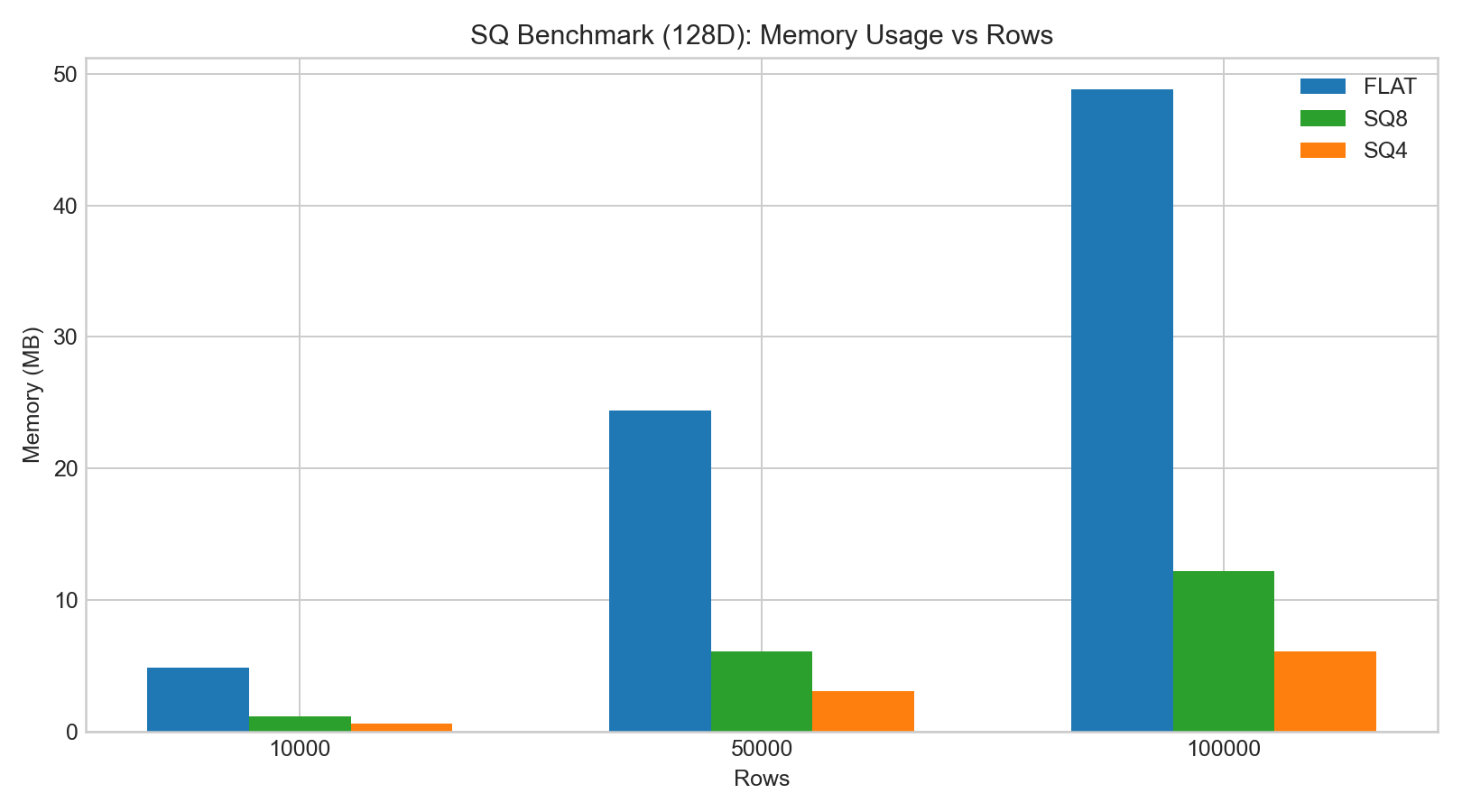
sq8roughly 4x vs float32 values,sq4roughly 8x).
- Weaknesses:
- Assumes distribution can be bucketed with fixed steps.
- If a dimension is highly non-uniform (for example, strong long-tail), quantization error can increase.
Faiss Source-Level Note (SQ)
Under the Doris + optimized Faiss implementation path, SQ training computes min/max statistics first, then expands the range slightly to reduce out-of-range risk at add time. A simplified shape is:
void train_Uniform(..., const float* x, std::vector<float>& trained) {
    trained.resize(2);
    float& vmin = trained[0];
    float& vmax = trained[1];
    // scan all values to get min/max
    // then optionally expand range by rs_arg
}
For non-uniform SQ, Faiss computes statistics per dimension (instead of one global range), which is why it typically behaves better when different dimensions have very different value scales.
Practical Observations
In the internal 128D/256D HNSW tests:
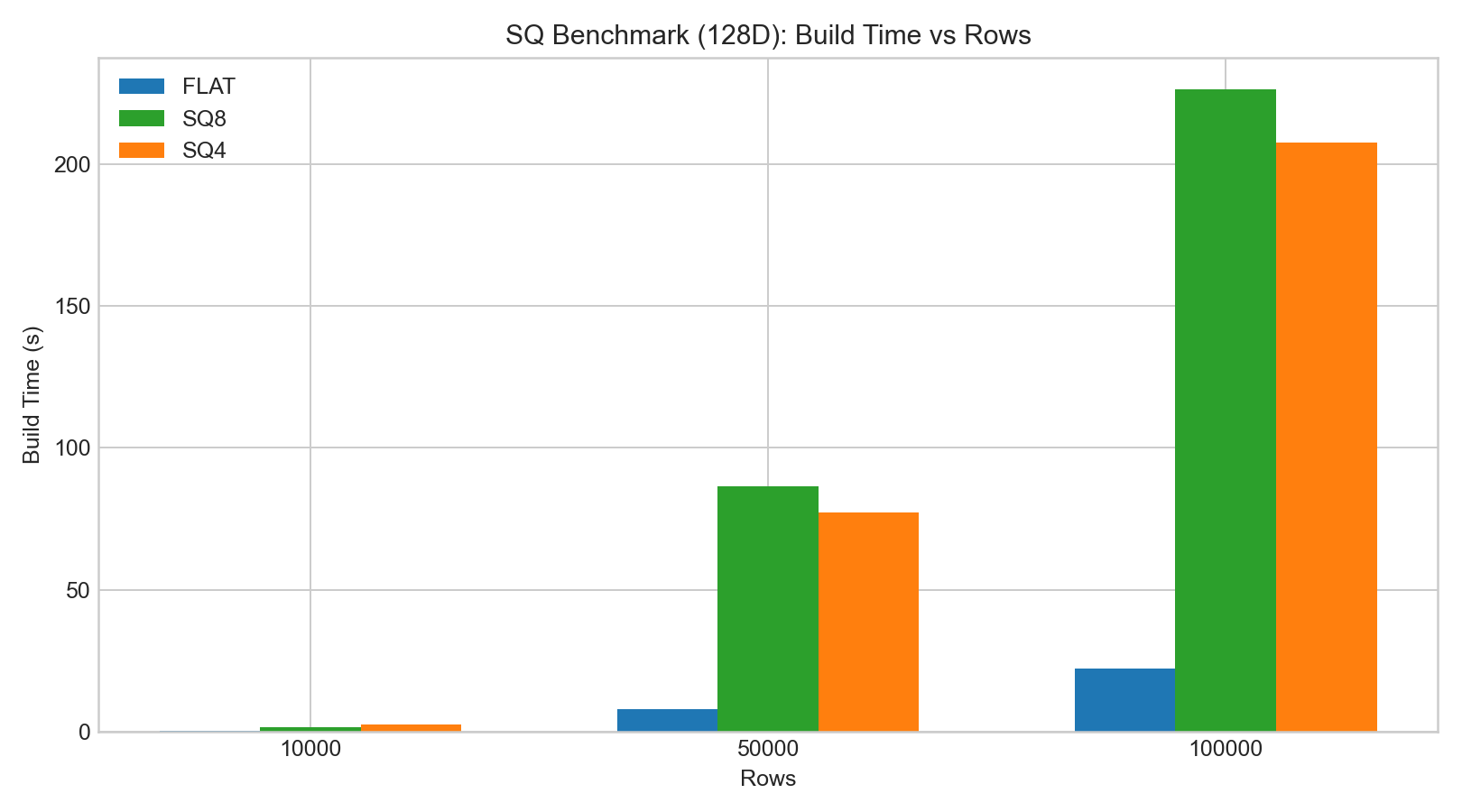
sq8generally preserved recall better thansq4.- SQ index build/add time was significantly higher than FLAT.
- Search latency change was often small for
sq8, whilesq4had larger recall drop.
The following bar charts are based on example benchmark data:
Product Quantization (PQ)
Principle
PQ splits a D-dim vector into M subvectors (D/M dimensions each), then applies k-means codebooks to each subspace.
Main parameters:
pq_m: number of subquantizers (subvectors)pq_nbits: bits per subvector code
Larger pq_m usually improves quality but increases training/encoding cost.
Why PQ Can Be Faster at Query Time
PQ can use LUT (look-up table) distance estimation:
- Precompute distances between query subvectors and codebook centroids.
- Approximate full-vector distance by table lookups + accumulation.
This avoids full reconstruction and can reduce search CPU cost.
Faiss Source-Level Note (PQ)
Under the same implementation path, Faiss ProductQuantizer trains codebooks over subspaces and stores them in a contiguous centroid table. A simplified shape is:
void ProductQuantizer::train(size_t n, const float* x) {
    Clustering clus(dsub, ksub, cp);
    IndexFlatL2 index(dsub);
    clus.train(n * M, x, index);
    for (int m = 0; m < M; m++) {
        set_params(clus.centroids.data(), m);
    }
}
Centroids are laid out as (M, ksub, dsub), where:
M: number of subquantizers,ksub: codebook size per subspace (2^pq_nbits),dsub: subvector dimension (D / M).
Practical Observations
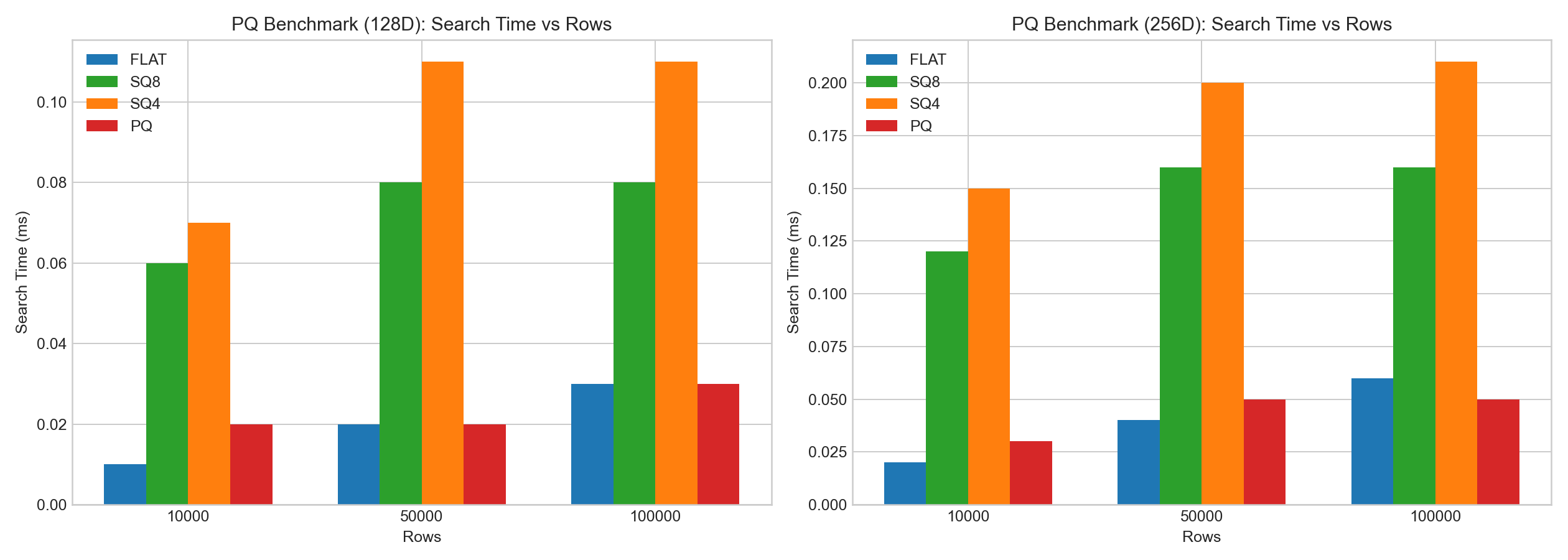
In the same internal tests:
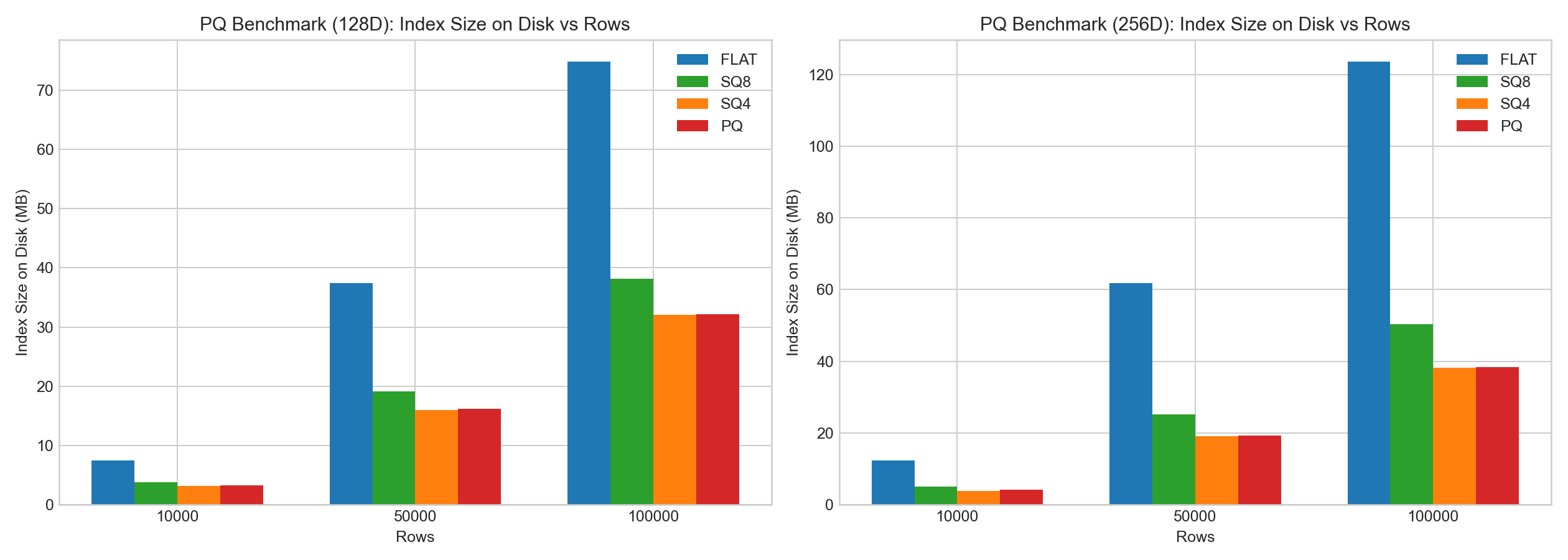
- PQ showed clear compression benefits.
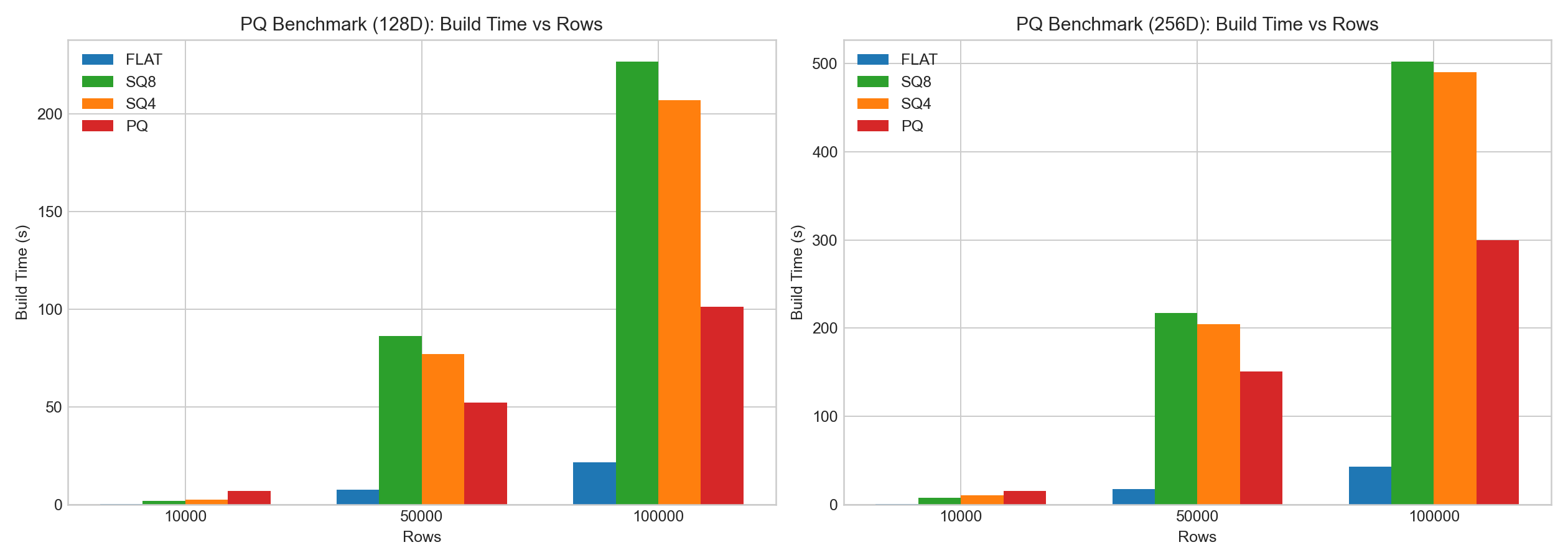
- PQ encoding/training overhead was high.
- Compared with SQ, PQ often had better search-time behavior due to LUT acceleration, but recall/build trade-offs depended on data and parameters.
The following bar charts are based on example benchmark data:
Practical Selection Guide for Doris
Use this as a starting point:
- Memory is sufficient and recall is top priority:
flat. - Need low risk compression with relatively stable quality:
sq8. - Extreme memory pressure and can accept lower recall:
sq4. - Need stronger memory-performance balance and can spend time tuning:
pq.
Recommended validation process:
- Start with
flatas baseline. - Test
sq8first; compare recall and P95/P99 latency. - If memory is still too high, test
pq(pq_m = D/2as first trial). - Use
sq4only when memory reduction has higher priority than recall.
Benchmarking Notes
- Absolute times are hardware/thread/dataset dependent.
- Compare methods under the same:
- vector dimension,
- index parameters,
- segment size,
- query set and ground truth.
- Evaluate both quality and cost:
- Recall@K,
- index size,
- build time,
- query latency.