Wide Table Storage Format V3
This feature is supported starting from Apache Doris 4.1.0. Set "storage_format" = "V3" in the PROPERTIES clause when creating a table to enable it.
The wide table storage format V3 restructures the Segment metadata layout for tables with a very large number of columns. By splitting column metadata out of the Footer and loading it on demand, V3 significantly reduces Segment opening latency and memory usage.
Applicable Scenarios
If your queries show that the "Segment opening" phase is very slow and memory usage is unusually high, and your case matches any scenario in the table below, enabling the V3 storage format is recommended:
| User scenario | Typical symptom | V3 recommended? |
|---|---|---|
| Wide tables (hundreds to thousands of columns) | Segment opening takes a lot of time and memory even when only a few columns are queried | Recommended |
Tables with VARIANT columns | After dynamic subcolumn expansion, the actual number of stored columns far exceeds the surface definition | Recommended |
| Deployed on object storage / tiered storage | Data resides on remote storage such as S3 or OSS, and cold query latency is sensitive | Recommended |
| Regular tables (a few dozen columns or fewer) | Segment opening overhead is negligible | No need to switch |
Typical pain point example: On a wide table with 7,000 columns and 10,000 Segments in total, opening the Segments takes about 65 seconds, with peak memory usage reaching 60 GB during the process. This overhead is unrelated to whether the query actually uses these columns; it is a pure "boarding cost".
Root Cause
The old format packs the metadata of all columns (ColumnMetaPB) together at the end of the Segment file inside the Footer, which leads to:
- Full metadata loading: Opening a Segment requires deserializing the entire Footer first. Even if the query only uses two columns, the full cost is paid.
- Footer size inflation: When the column count reaches several thousand, the Footer itself can grow to several MB.
- Amplification effect on remote storage: Network latency and high read costs on object storage further amplify the overhead above.
In other words, even if a SQL statement only queries 2 columns, Doris still has to read the metadata of all columns in the Segment into memory and deserialize it before scanning can begin. The more columns and the more Segments there are, the more dramatic this overhead becomes.
Key V3 Optimizations
V3 restructures the storage format along three dimensions:
Optimization 1: On-Demand Column Metadata Loading
V3 splits column metadata out of the Footer and places it in a separate region of the file. The Footer only keeps lightweight pointers to the metadata of each column.
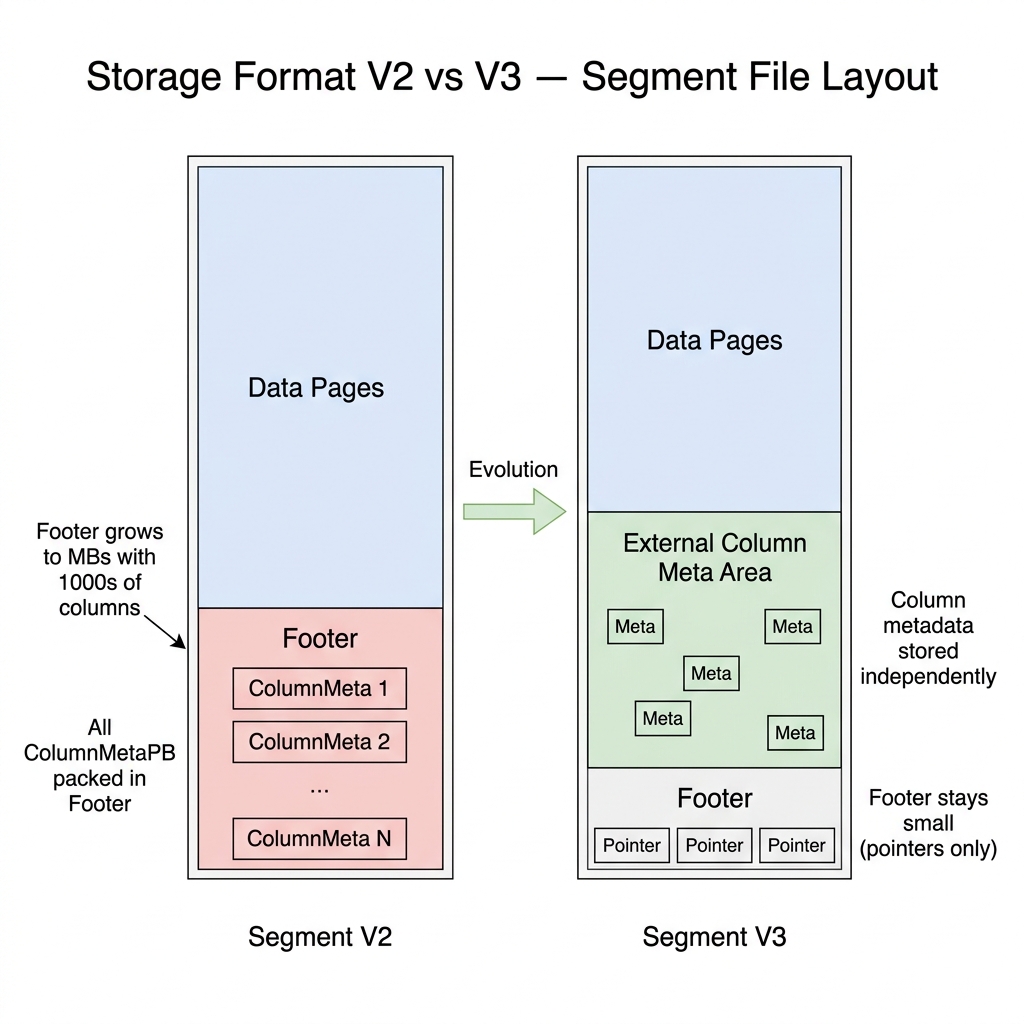
When opening a Segment, the system only reads a slim Footer; the metadata of the columns actually used is fetched only when needed. This is the primary source of performance improvement in wide table scenarios, and is especially noticeable on object storage.
Optimization 2: Plain Encoding by Default for Numeric Types
V3 switches the default encoding for numeric types such as INT and BIGINT from BitShuffle to PLAIN_ENCODING (raw binary). Combined with LZ4 / ZSTD compression, this delivers faster reads and lower CPU overhead during large bulk scans.
Optimization 3: More Compact Plain Encoding for Strings
For strings and JSONB, V3 introduces BINARY_PLAIN_ENCODING_V2, which uses a streaming layout of [length(varuint)][raw data]. It eliminates the trailing offset table required by the old encoding and is more compact in storage.
Measured Results
Test conditions: a wide table with 7,000 columns and 10,000 Segments in total.
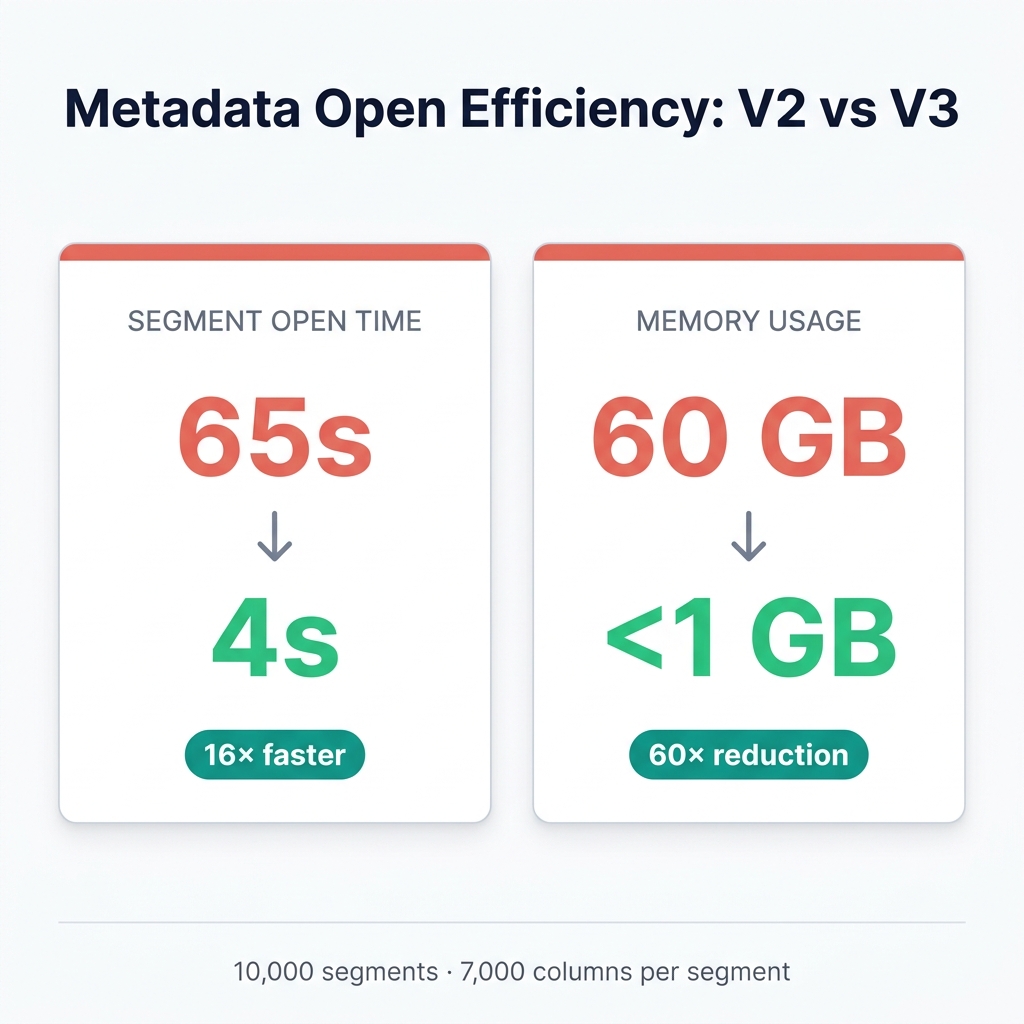
| Metric | Old format | V3 format | Improvement |
|---|---|---|---|
| Segment opening time | 65 s | 4 s | 16x faster |
| Memory usage when opening | 60 GB | < 1 GB | 60x lower |
How to Enable
Explicitly specify storage_format as V3 in the PROPERTIES clause of the CREATE TABLE statement:
CREATE TABLE table_v3 (
    id BIGINT,
    name VARCHAR(128),
    attrs VARIANT
)
DISTRIBUTED BY HASH(id) BUCKETS 32
PROPERTIES (
    "storage_format" = "V3"
);
Recommendations
- Recommended to enable: wide tables with many columns (hundreds or more), tables with
VARIANTcolumns, and tables deployed on object storage or tiered storage. - No need to switch: regular tables with few columns (a few dozen or fewer); the old format is already sufficient.
Related Documentation
- Data Compression: learn about V3's coordinated optimizations of encoding and compression for numeric and string types.