Doris Operator Resource Model
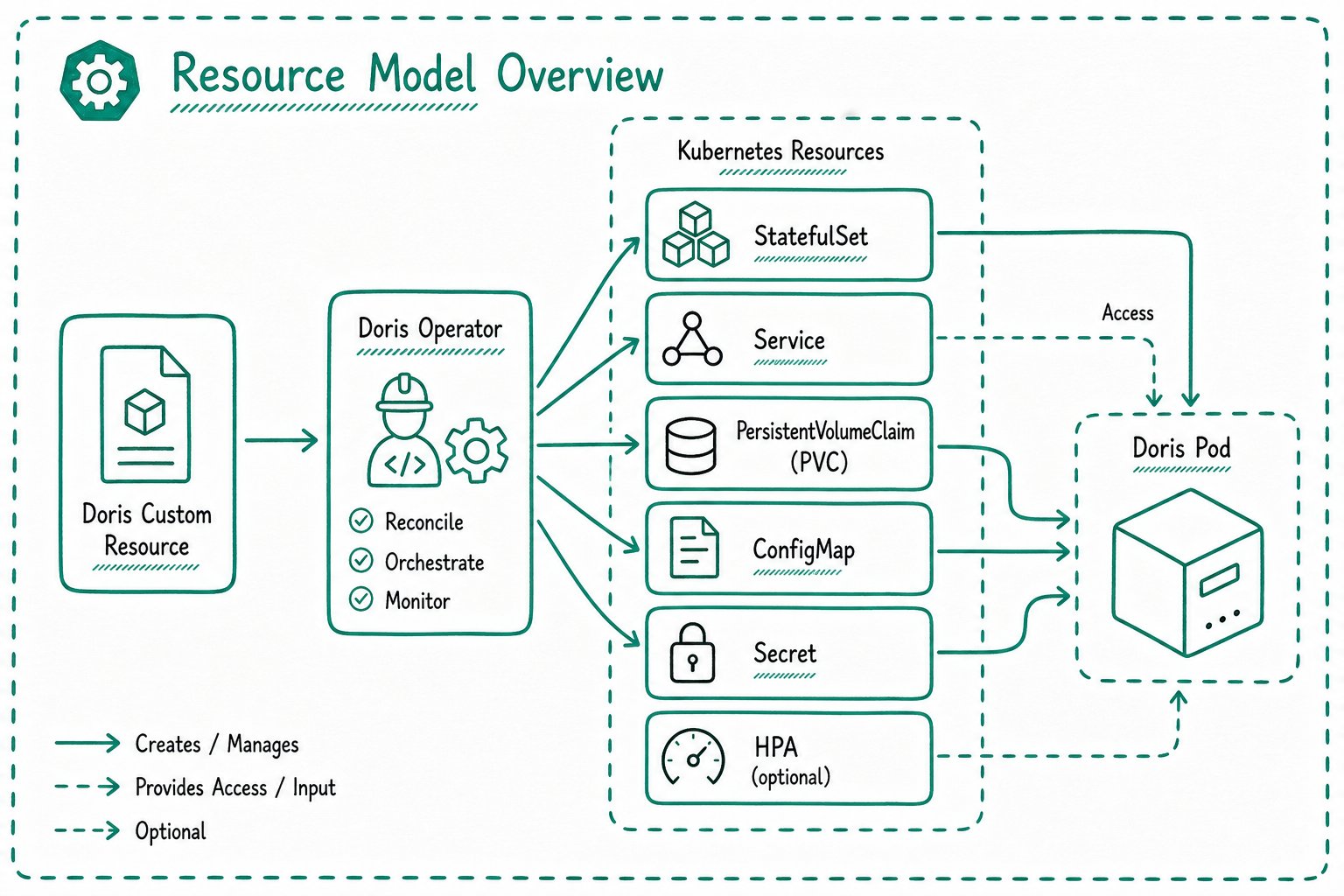
The Doris Operator resource model describes how Doris cluster components are mapped to native Kubernetes resources. Understanding this mapping helps you judge which fields affect which underlying resources and makes troubleshooting easier.
This document does not list every field. For field-level configuration, see the corresponding deployment and configuration documents.
Minimal example
The following example shows a minimal DorisCluster. FE and BE are mapped to their corresponding StatefulSet, Service, PVC, and related resources.
apiVersion: doris.apache.com/v1
kind: DorisCluster
metadata:
  name: demo
  namespace: doris
spec:
  feSpec:
    replicas: 3
    image: apache/doris:fe-2.1.8
  beSpec:
    replicas: 3
    image: apache/doris:be-2.1.8
Overview
Regardless of deployment mode, the user directly manages a Doris custom resource. The Operator uses that resource to create native Kubernetes resources, and those resources run Doris components.
DorisCluster
DorisCluster is used for compute-storage integrated deployments. It usually contains FE, BE, CN, and Broker components.
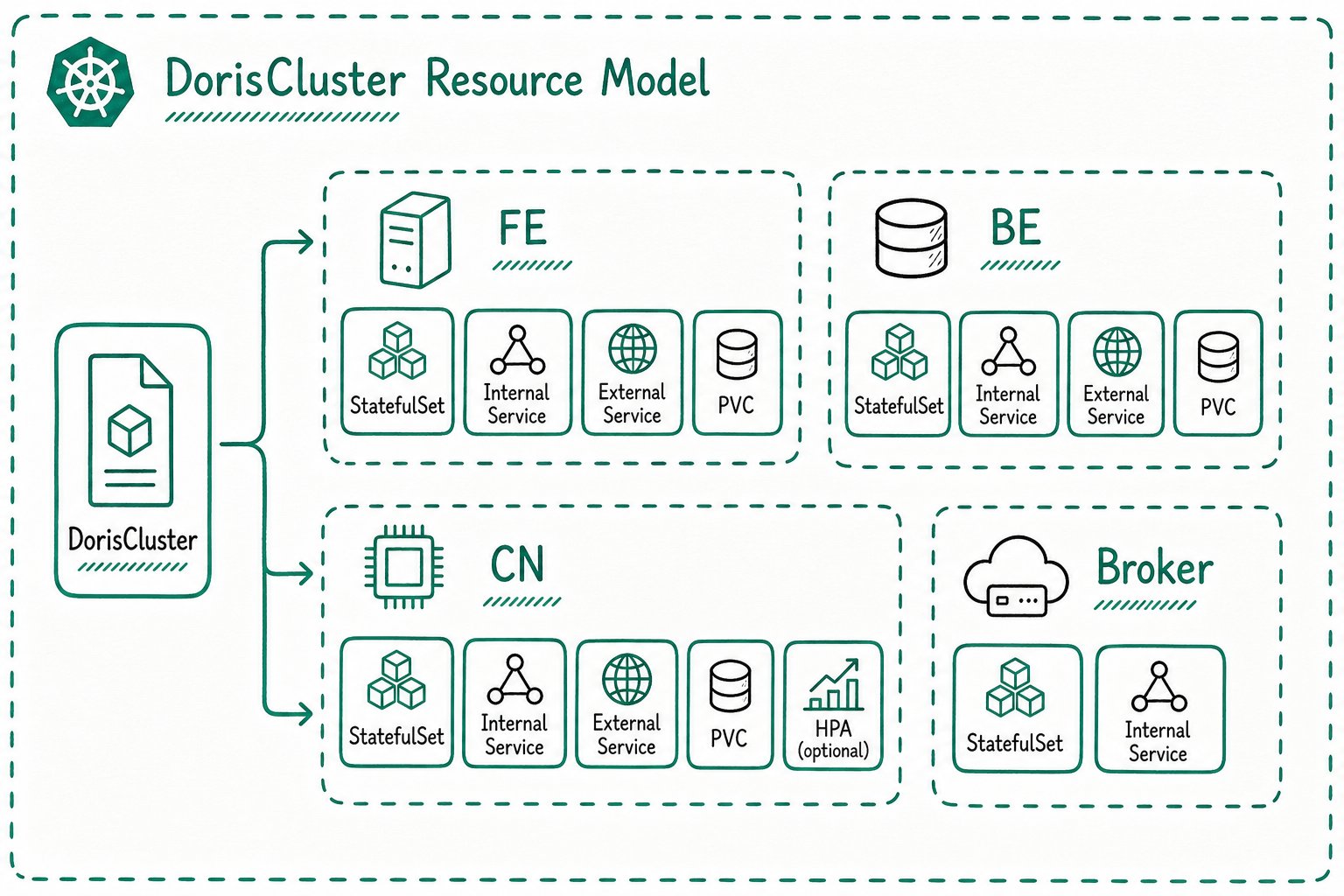
| Component | Description | Main Kubernetes resources |
|---|---|---|
| FE | Metadata management, SQL access, and query coordination | StatefulSet, internal Service, external Service, PVC |
| BE | Data storage and execution | StatefulSet, internal Service, external Service, PVC |
| CN | Compute execution for elastic compute scenarios | StatefulSet, internal Service, external Service, PVC, HPA |
| Broker | External storage access proxy; whether it is needed depends on Doris version and workload | StatefulSet, internal Service |
DorisDisaggregatedCluster
DorisDisaggregatedCluster is used for compute-storage decoupled deployments. It usually contains MetaService, FE, and one or more ComputeGroups.
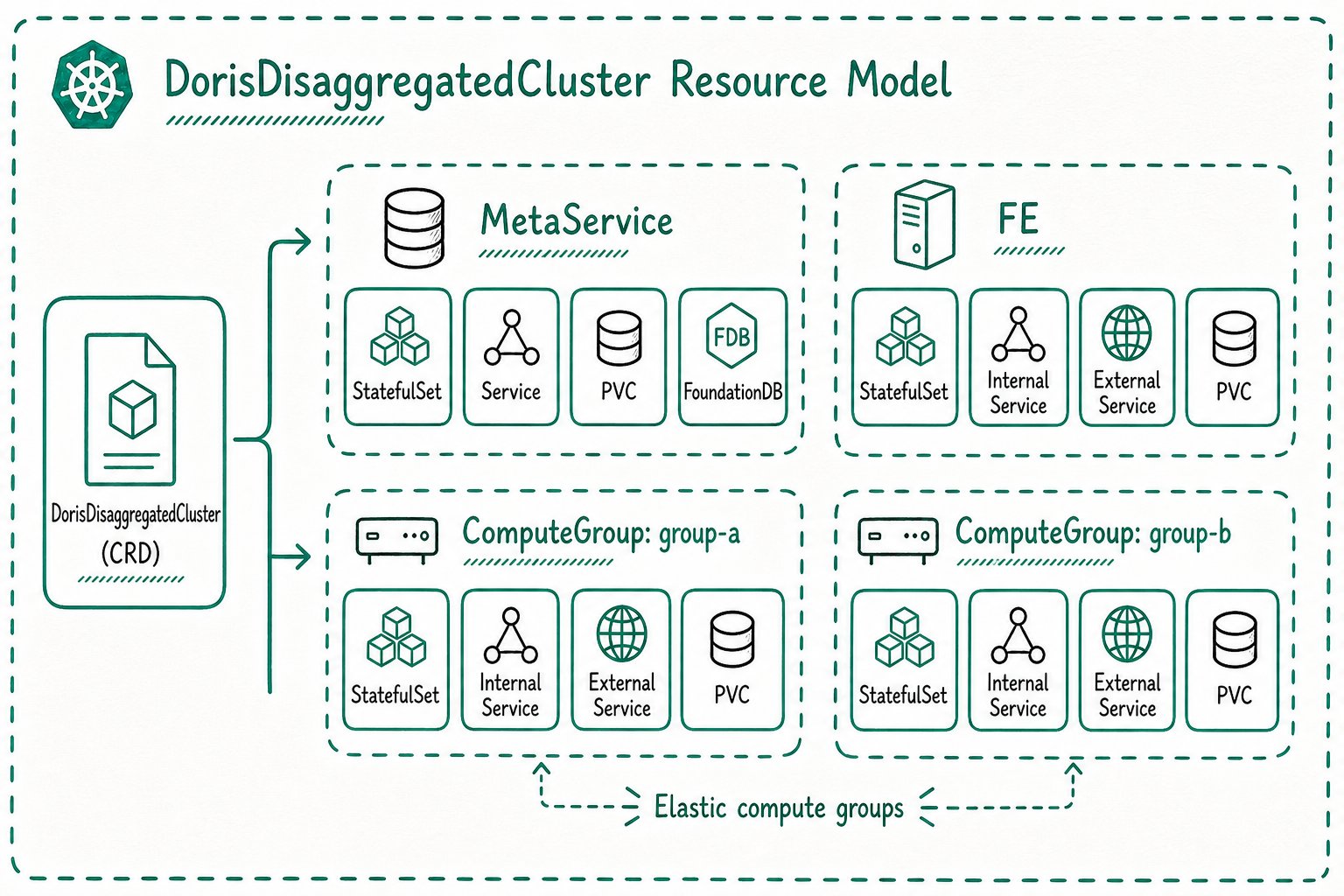
| Component | Description | Main Kubernetes resources |
|---|---|---|
| MetaService | Metadata service for compute-storage decoupled clusters | StatefulSet, Service, PVC |
| FE | SQL access, query coordination, and metadata access entry point | StatefulSet, internal Service, external Service, PVC |
| ComputeGroup | Independent compute resource group for running compute tasks | StatefulSet, internal Service, external Service, PVC |
| FoundationDB | Metadata dependency for compute-storage decoupled clusters | External service or managed by fdb-kubernetes-operator |
Service types
Doris Operator creates Services for different purposes.
| Service type | Purpose | Typical use |
|---|---|---|
| internal Service | Stable network identity and internal communication | StatefulSet DNS, component discovery, Pod-to-Pod access |
| external Service | External access entry point | Client connections and external system access |
An internal Service is usually not the business access entry point. Depending on the scenario, an external Service may be configured as ClusterIP, NodePort, or LoadBalancer.
Storage
Doris is a stateful system. FE, BE, CN, MetaService, and ComputeGroups may all need persistent directories. The Operator binds persistent storage through PVC templates.
Pay attention to:
- Whether the Kubernetes cluster has an available StorageClass.
- Whether PVC capacity is sufficient for data and log growth.
- Whether access mode fits the workload.
- Whether configured Doris directories match PVC mount paths.
If PVCs cannot be bound, the Operator keeps waiting and the affected Pods cannot start.
Configuration and authentication resources
Doris Operator supports ConfigMap and Secret for configuration and sensitive data.
| Resource | Common use |
|---|---|
ConfigMap | Startup configuration for FE, BE, CN, Broker, MetaService, and ComputeGroups |
Secret | Passwords, access credentials, and keytabs |
authSecret | Credentials used by Doris Operator for node registration, decommissioning, and related management actions |
kerberosInfo | Kerberos configuration and keytab mounting |
serviceAccount | Kubernetes ServiceAccount used when components need to access cloud or external services |
Whether a configuration update triggers a restart depends on the field and Operator settings. For example, in compute-storage integrated mode, enableRestartWhenConfigChange controls whether core ConfigMap changes trigger a rolling restart.
Naming
Operator-managed resources usually use the cluster name and component name as prefixes, which makes ownership easy to identify.
If a compute-storage integrated cluster is named demo, common names look like:
demo-fe
demo-fe-internal
demo-fe-service
demo-be
demo-be-internal
demo-be-service
demo-cn
demo-cn-internal
demo-cn-service
demo-broker
demo-broker-internal
If a compute-storage decoupled cluster is named demo and a ComputeGroup is named adhoc-query, common names look like:
demo-ms
demo-fe
demo-fe-internal
demo-adhoc-query
demo-adhoc-query-external
Actual names can vary slightly by version or configuration. Treat kubectl get output as the source of truth.
Dependencies between components
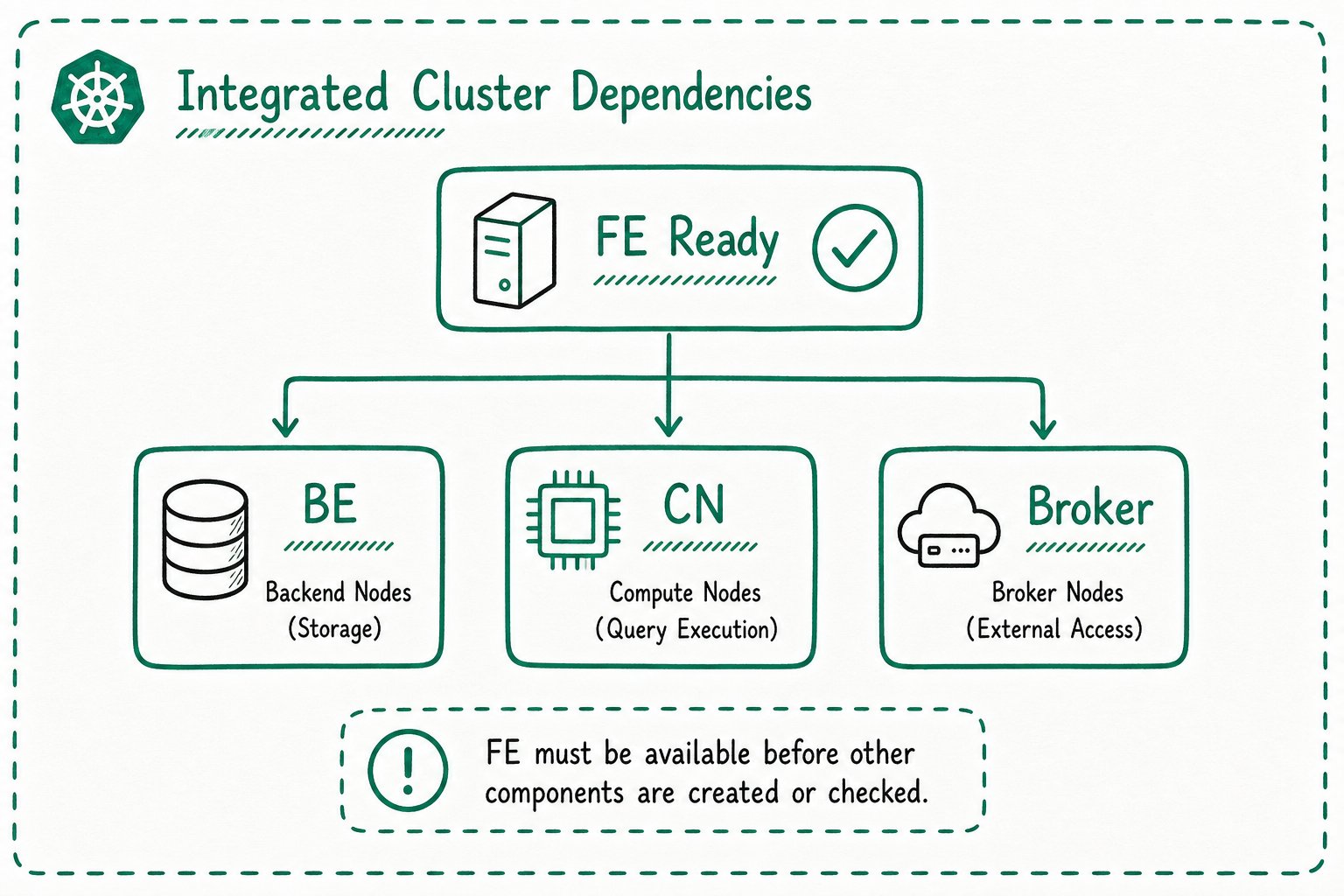
The resource model also implies component dependencies.
In a compute-storage integrated cluster, FE is the entry point for other components to register and access Doris metadata:
In a compute-storage decoupled cluster, MetaService is ready first, FE depends on it, and ComputeGroups depend on FE:
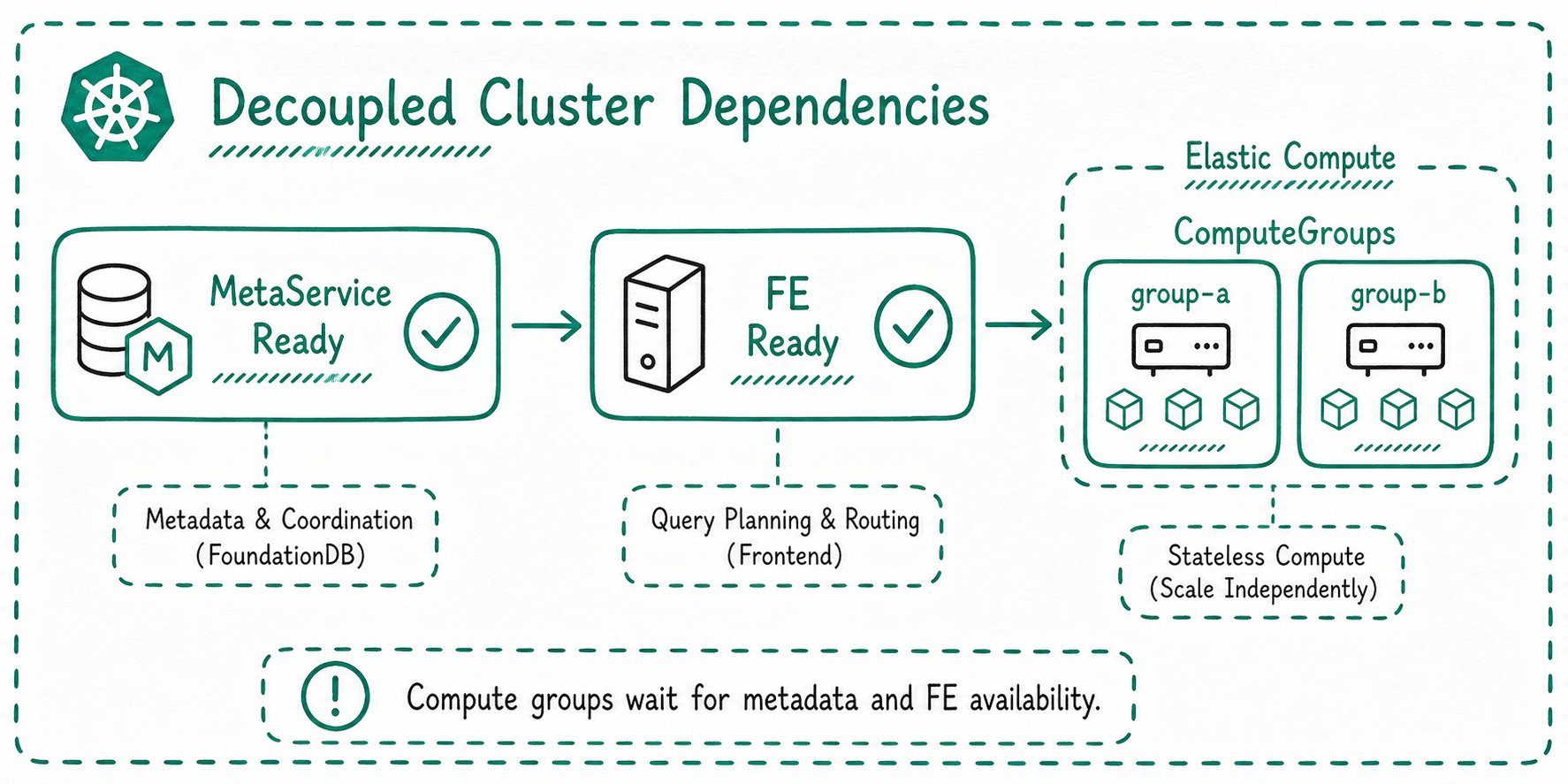
When an upstream component is not ready, downstream components may keep waiting or reconciling. That is expected behavior. For the execution order of creation and changes, see Doris Operator Lifecycle Management.