Pluggable Authentication and Authorization
TL;DR Apache Doris splits identity (who you are) from policy (what you can do), and you can swap the backend for either side without forking the FE. The MySQL handshake hits an
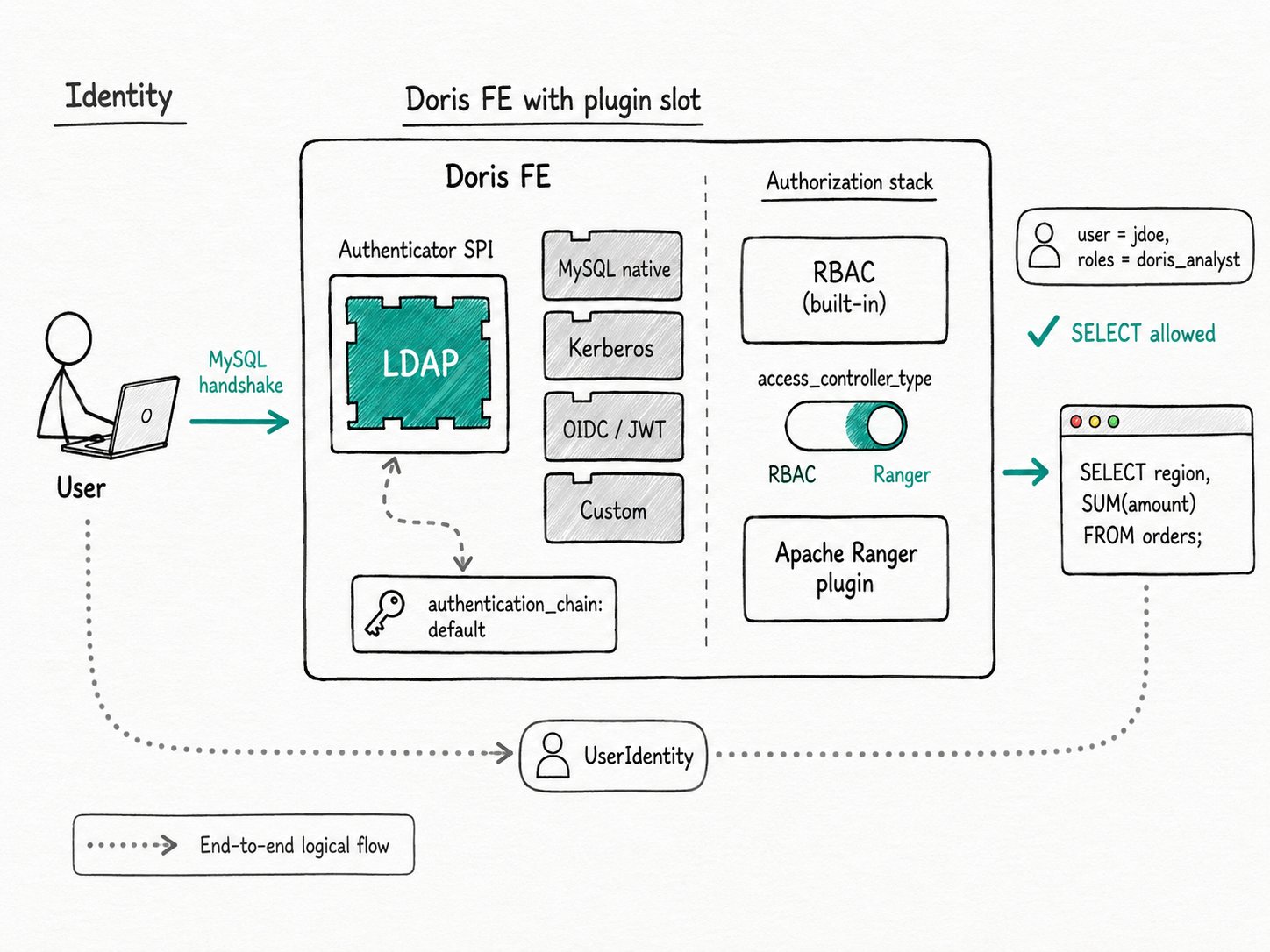
Authenticatorchosen byauthentication_type: built-in password, LDAP, or any plugin discovered through Java SPI. Authorization runs through aCatalogAccessControllerchosen byaccess_controller_type: the built-in RBAC engine, or Apache Ranger for centralized policy. Set the config, drop the plugin jar, restart, done.
Why use pluggable authentication and authorization in Apache Doris?
Apache Doris pluggable authentication and authorization let an existing IAM stack (LDAP, Kerberos, OIDC, Ranger) own identity and policy for the warehouse, so the platform team does not maintain a parallel user list. Most teams arrive at Doris with an IAM stack already in place. There is an LDAP directory, a Kerberos realm, an OIDC provider for SSO, and a Ranger or Sentry deployment that owns Hive permissions. A warehouse that ignores all of it forces the platform team to maintain a parallel user list, sync passwords by script, and explain to auditors why query history shows different identities than the rest of the lakehouse. Pair the same identity with multi-catalog federation and data lineage, and audit trails line up across the lake.
Apache Doris treats both authentication and authorization as plug-in points. Authentication backends discover themselves through Java SPI; so do authorization backends. Switching from local passwords to LDAP is one config line. Switching from built-in RBAC to Ranger is a different config line. The two decisions are independent: an OIDC plugin in front of Ranger is fine, and so is LDAP in front of built-in RBAC.
- One IdP for the whole data platform instead of a separate Doris user list.
- Centralized policy in Ranger that already governs Hive, HDFS, and Iceberg, with Doris hooked into the same service.
- Custom auth (proprietary token formats, tenant-aware password verification) without patching FE source.
What is Apache Doris pluggable authentication and authorization?
Apache Doris pluggable authentication and authorization is two side-by-side extension points on the FE. The first is the Authenticator interface, called once per MySQL handshake to turn the credentials in the auth packet into a UserIdentity. The second is the CatalogAccessController interface, called on every query to check whether that identity can touch the catalog, database, table, or column. Both load through java.util.ServiceLoader, so a third party jar dropped on the classpath registers itself.
Key terms
authentication_type: FE config that picks the primary authenticator. Built-in values aredefault(aliaspassword) andldap; any other string resolves as a plugin name.authentication_chain: comma-separated list of fallback authenticators tried after the primary one rejects. Useful for keeping local break-glass users while LDAP or OIDC handles normal logins.access_controller_type: FE config that picks the authorizer for the internal catalog.defaultkeeps built-in RBAC;ranger-dorishands every check to the Ranger plugin.AuthenticatorFactory/AccessControllerFactory: the SPI hooks listed inMETA-INF/services. Implement one to add a new backend.- External catalog authorizer: each external catalog (Hive, Iceberg) can pick its own controller, so a Hive catalog can defer to its existing Ranger Hive policies while the internal catalog uses Doris RBAC.
How does Apache Doris pluggable authentication and authorization work?
Apache Doris pluggable authentication and authorization runs two independent SPI chains: an Authenticator resolves the MySQL handshake into a UserIdentity, then a per-catalog CatalogAccessController evaluates every statement, including row filters and column masks.
- Pick the authenticator at startup.
AuthenticatorManagerreadsauthentication_type, normalizes the value, and resolves it throughServiceLoader<AuthenticatorFactory>. Built-in factories (DefaultAuthenticatorFactory,LdapAuthenticatorFactory) ship in the FE jar; custom factories live infe/plugins/. If no legacy factory matches, the manager falls back toAuthenticationPluginAuthenticator, which handles OIDC, OAuth2, and JWT. - Authenticate the connection. When a client opens a MySQL connection, the chosen authenticator inspects the handshake. Native password compares the scrambled hash, LDAP binds against the directory, OIDC validates a JWT and pulls claims from it. Success returns a
UserIdentity; failure returns a typed reason. - Try the chain on failure. If
authentication_chainis set, the manager runs the listed authenticators in order. A common pattern isauthentication_type = ldapwithauthentication_chain = default, so admins keep local password access even when LDAP is unreachable. - Hand off to the authorizer. Once the identity is bound to the session, every statement goes through
AccessControllerManager. The internal catalog uses whateveraccess_controller_typeselected. An external catalog uses whatever the catalog propertyaccess_controller.classselected, so a single cluster can mix Doris RBAC for the internal catalog with Ranger for a Hive catalog. - Evaluate row and column policies. The same controller exposes hooks for column masking and row filtering. Built-in RBAC reads the policies stored by
CREATE ROW POLICY. The Ranger controller callsevalRowFilterPoliciesandevalDataMaskPolicyagainst the Ranger plugin, so the same Hive masking rules apply to a Doris query.
Quick start
# fe.conf: enable LDAP for everyone, keep local passwords as fallback
authentication_type = ldap
authentication_chain = default
access_controller_type = ranger-doris
-- Roles in Doris match LDAP group names; Ranger holds the actual grants
CREATE ROLE doris_analyst;
CREATE ROLE doris_etl;

-- Local break-glass account that survives LDAP / Ranger outages
CREATE USER 'breakglass'@'127.0.0.1' IDENTIFIED BY 'rotate-me';
GRANT 'admin' TO 'breakglass'@'127.0.0.1';
Expected result
mysql> SELECT current_user(), user();
+---------------------+----------------------+
| current_user()      | user()               |
+---------------------+----------------------+
| jdoe@'%'            | jdoe@'10.0.4.21'     |
+---------------------+----------------------+
jdoe logged in with the LDAP password, picked up the doris_analyst role through LDAP group mapping, and any subsequent SELECT is checked against the Ranger policy bound to the doris service.
When should you use Apache Doris pluggable authentication and authorization?
Use Apache Doris pluggable authentication and authorization when an existing IdP or policy service should own warehouse identity, and the FE just consumes credentials and policy decisions.
Good fit
- Enterprises that already run an IdP (LDAP, AD, OIDC, Kerberos KDC) and want Doris to share it instead of maintaining a parallel user list.
- Lakehouse deployments that already use Ranger for Hive, HDFS, or Iceberg, and want the same policies on Doris-managed tables. See Ranger Authorization.
- Multi-tenant SaaS where each tenant brings its own identity provider, behind a custom
AuthenticatorFactory. - Teams that need cleartext or token-based handshakes (OIDC, JWT) for SSO from BI tools, with TLS enforced by Doris.
Not a good fit
- Air-gapped clusters with no reachable LDAP, KDC, or Ranger Admin. The plugin will keep retrying and queries pay the round-trip. Stick with built-in RBAC and local accounts.
- Latency-critical short queries where the per-query Ranger policy lookup matters. Ranger caches policies locally and the hit path is cheap, but the first request after a policy refresh is not free.
- Backends Doris does not yet ship a built-in factory for. Kerberos / GSSAPI authentication for the MySQL handshake itself is not in the box. The Ranger Admin server can sit behind Kerberos, but the FE-to-client leg needs an OIDC token or an LDAP bind. Write a custom
AuthenticatorFactoryif you need it. - Mixing Ranger and
GRANTstatements on the same internal catalog. Onceaccess_controller_type = ranger-dorisis on, built-in RBAC stops accepting changes. Pick one source of truth and run with it.
Further reading
- Authentication and Authorization overview: the full conceptual model, including User Identity, roles, and the priority rules that decide which user a connection lands on.
- Built-in Authentication: password policies, expiration, lockout, and the
validate_password_policystrength rules. - LDAP Authentication:
ldap.confreference, group-to-role mapping, LDAPS setup, and the cleartext plugin steps for MySQL and JDBC clients. - Ranger Authorization: installing the Doris Ranger plugin, policy examples for catalog/database/table/column, and the row-level filter and masking flows.
- Security Overview: the wider picture, including audit logs, SSL transport, and UDF guidance.
- Multi-Catalog: how Ranger-style authorization plugs into per-catalog access controllers for Hive, Iceberg, and other external sources.