Prepared Statement
TL;DR Apache Doris supports server-side prepared statements over the MySQL wire protocol. Setting
useServerPrepStmts=trueon the JDBC URL makes the FE parse and plan a statement once per session and reuse that plan on everyEXECUTE. On high-QPS point-query traffic the short-circuit path delivers roughly 4x more throughput; batch INSERTs and any repeated query shape stop paying parse and plan cost per row.
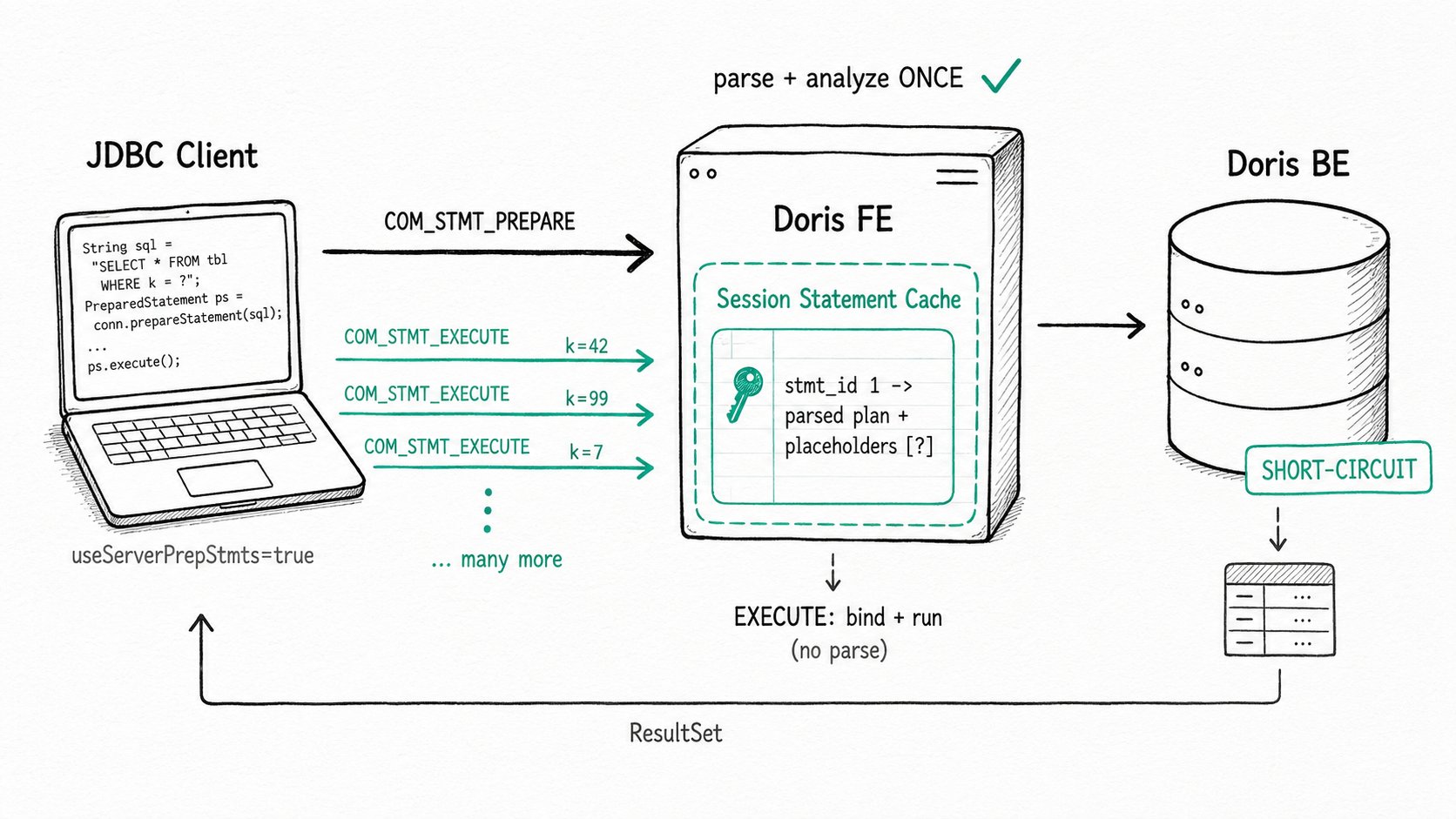
Why use prepared statements in Apache Doris?
Apache Doris prepared statements cache the parsed plan per session and reuse it on every EXECUTE, removing the FE-side parse, analyze, and optimize cost that dominates high-QPS workloads. Most analytical engines pay parse and plan cost on every query. That cost is invisible in a daily report job. It is the whole story once a service starts asking the same query thousands of times per second. A user-facing dashboard reads a row by primary key on every click. A feature store reads a vector by entity ID on every prediction. A bulk loader fires the same INSERT INTO t VALUES (?, ?, ?) over and over.
In all three cases the SQL text is identical; only the parameters change. Re-parsing and re-planning that statement on every call burns FE CPU for no reason. At a few hundred QPS the FE saturates before the BE is doing any real work, and adding BE nodes does nothing for you. PreparedStatement is what you reach for there.
- The Frontend planner is the bottleneck at high QPS, not the storage engine.
- Repeating queries pay parse, analyze, optimize, and serialization cost on every call.
- A separate KV store is a heavy answer to "make my point queries cheap."
What is the Apache Doris prepared statement?
The Apache Doris prepared statement is a server-side implementation of the MySQL wire-protocol pair COM_STMT_PREPARE / COM_STMT_EXECUTE (with COM_STMT_CLOSE to evict), served by the FE and backed by a per-session plan cache. When the client opens a connection with useServerPrepStmts=true, the JDBC driver issues COM_STMT_PREPARE once per distinct SQL text. The FE parses, analyzes, and stores the plan in a per-session cache keyed by statement ID. Every subsequent EXECUTE ships only the binary parameter bytes. The FE binds the values to the cached plan and runs it.
Key terms
useServerPrepStmts=true: JDBC URL flag that switches the MySQL Connector/J driver from client-side string interpolation to the binaryCOM_STMT_PREPARE/COM_STMT_EXECUTEround trips.cachePrepStmts=true: a separate JDBC flag that caches the prepared-statement handle on the client. Without it, every call re-issuesCOM_STMT_PREPAREand throws away the speedup.- Per-session statement cache: an in-memory map on the FE (
ConnectContext.preparedStatementContextMap) holding the parsedPrepareCommand, theStatementContext, and an optionalShortCircuitQueryContext. Capped bymax_prepared_stmt_count(default 100,000). - Placeholder (
?): a positional parameter bound at execute time. A single statement can carry up to 65,536 of them. ShortCircuitQueryContext: an extra cache that lives alongside the prepared plan when the query qualifies for the short-circuit point-query path. It holds the serialized descriptor table, output expressions, and a UUID the BE uses to look up its own pre-built structures.
How does the Apache Doris prepared statement work?
The Apache Doris prepared statement runs in five steps: prepare the SQL on the FE, cache the short-circuit plan when eligible, execute with binary parameter bytes, optionally audit, and close to evict.
- Prepare. The client sends
COM_STMT_PREPARE "SELECT ... WHERE k1 = ?". The FE parses the SQL, runs Nereids analysis, stores aPreparedStatementContextin the connection's map, and returns the statement ID and parameter count. - Cache the short-circuit path (if eligible). When the query is a single Unique Key table with equality predicates on the full key, the rewrite rule
LogicalResultSinkToShortCircuitPointQueryflips a flag, and the FE serializes the descriptor table and output expressions into aShortCircuitQueryContextkeyed by a UUID. - Execute. Each
COM_STMT_EXECUTEcarries the statement ID, a null bitmap, type codes (the first time), and the parameter bytes. The FE decodes them intoLiteralvalues, drops them into the placeholder slots, and runs the cached plan. No re-parse, no re-analyze, no re-optimize. - Audit (optional). With
enable_prepared_stmt_audit_log=true,fe.audit.logreconstructs the statement with parameter values for debugging. The default is off because high-QPS traffic floods the log. - Close.
COM_STMT_CLOSEevicts the entry from the session cache. Closed connections drop the whole map.
Quick start
CREATE TABLE tbl_point_query (
  k1 INT,
  v1 VARCHAR(64)
)
UNIQUE KEY(k1)
DISTRIBUTED BY HASH(k1) BUCKETS 1
PROPERTIES (
  "enable_unique_key_merge_on_write" = "true",
  "light_schema_change" = "true",
  "store_row_column" = "true"
);
String url = "jdbc:mysql://fe-host:9030/db"
    + "?useServerPrepStmts=true&cachePrepStmts=true"
    + "&prepStmtCacheSize=500&prepStmtCacheSqlLimit=1024";

try (Connection c = DriverManager.getConnection(url, "root", "");
     PreparedStatement ps = c.prepareStatement(
         "SELECT * FROM tbl_point_query WHERE k1 = ?")) {
    ps.setInt(1, 42);
    try (ResultSet rs = ps.executeQuery()) { /* ... */ }
}
Expected result
In fe.audit.log, the second and later calls show:
Stmt=EXECUTE(-2147481418)
instead of the raw SQL. That is the signal the cached plan is being reused. Pair it with EXPLAIN, which should show SHORT-CIRCUIT on the scan node, to confirm both layers are active.
When should you use Apache Doris prepared statements?
Apache Doris prepared statements fit high-QPS point queries on Unique Key tables, repeated batch INSERTs, and any client-side workload that fires the same statement thousands of times per second. They are not a fit for one-off ad-hoc queries, drivers without clean server-side support, or statements with non-deterministic functions on the short-circuit path.
Good fit
- High-QPS point queries on Unique Key tables, where parse cost dominates.
- Batch INSERTs over Group Commit, where a loader fires the same
INSERT INTO t VALUES (?, ?, ?)thousands of times per second. - Any query the same client repeats at meaningful rates: feature lookups, status checks, allow-listing, online-service reads.
- Workloads where you would rather not stand up a separate KV store next to Apache Doris.
Not a good fit
- One-off ad-hoc queries. The
PREPAREround trip costs more than the parse it saves. - Drivers without clean server-side prepared-statement support. The Rust
sqlxdriver, for example, has reported issues with Apache Doris's implementation. Use a MySQL Connector that talks the binary protocol cleanly. - Connections that set
useServerPrepStmts=truewithoutcachePrepStmts=true. Every call re-issuesCOM_STMT_PREPARE, which is slower than the default client-side mode. - Statements with non-deterministic functions (
NOW(),RAND()). The BE refuses to reuse the cached short-circuit context, so you only save parse cost. - Range and aggregate queries, if you are hoping for the short-circuit speedup. PreparedStatement still saves parse cost, but the BE runs a normal distributed plan. For those workloads, lean on data pruning instead.
Performance and verification
Doris reports a 4x or better throughput improvement from PreparedStatement on point-query workloads where FE CPU is the bottleneck. This is the same 4x cited from the short-circuit angle in the High-Concurrency Point Query card — one combined gain, not two stackable ones. The full high-concurrency stack (Unique Key + Merge-on-Write + row store + row cache + short-circuit + PreparedStatement) reaches 30,000+ QPS per node on YCSB on a 16-core / 64GB machine, with average latency cut by 96% versus the un-optimized baseline. The PreparedStatement contribution is hard to isolate from the rest of the stack; treat 4x as the planning floor when the FE is your ceiling.
Two checks tell you the path is live:
fe.audit.logshowsStmt=EXECUTE(stmtId)for repeat calls instead of the raw SQL.- For point queries,
EXPLAINshowsSHORT-CIRCUITon the scan node.
If FE CPU is still the ceiling, scale Observers and use JDBC load balancing: jdbc:mysql:loadbalance://h1,h2,h3/db?useServerPrepStmts=true&cachePrepStmts=true.
Further reading
- High-concurrency point query (full guide)
- High-Concurrency Point Query feature card
- Group Commit for high-throughput INSERTs
- Data pruning for non-point queries
- Unique Key: the partner table model for KV-style point lookups when combined with
store_row_column.