Storage Format V3
Storage Format V3 is the successor to Segment V2. The main change: column metadata is no longer packed inside the Segment Footer, but stored in a separate area of the file. This removes the metadata bottleneck that V2 hits when tables grow to hundreds or thousands of columns.
Key Optimizations
External Column Meta
In V2, every column's ColumnMetaPB sits in the Segment Footer. When a table has hundreds or thousands of columns, the Footer can reach several MB. Opening a Segment means loading and deserializing all of that, even if the query only touches two columns.
V3 moves ColumnMetaPB out of the Footer into a dedicated area in the file. The Footer keeps only lightweight pointers.
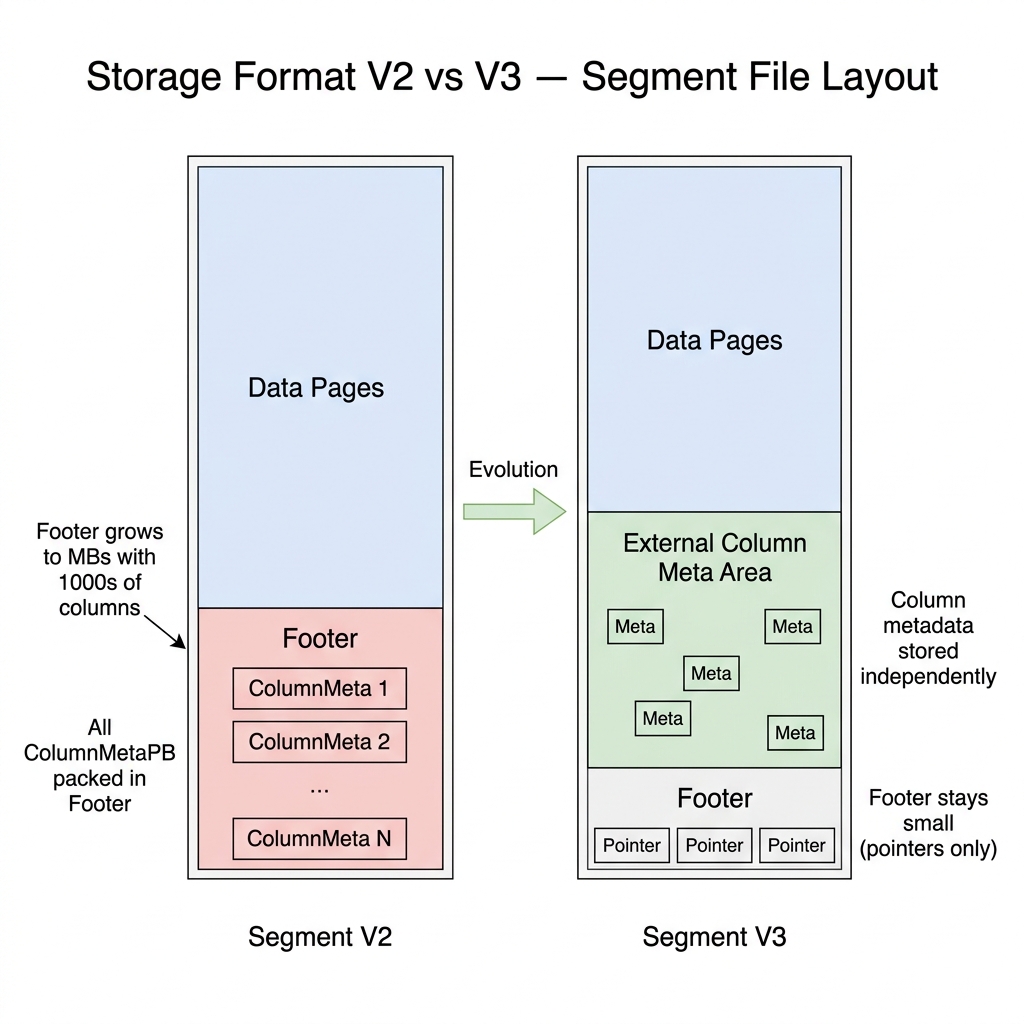
Result: the system loads a small Footer first, then fetches metadata only for the columns the query needs. On object storage (S3, OSS), this cuts cold-start latency considerably.
Integer Type Plain Encoding
V3 switches the default encoding for numeric types (INT, BIGINT, etc.) from BitShuffle to PLAIN_ENCODING (raw binary). With LZ4 or ZSTD compression on top, this combination reads faster and uses less CPU than BitShuffle during large scans.
Binary Plain Encoding V2
V3 introduces BINARY_PLAIN_ENCODING_V2 for strings and JSONB. The new layout uses [length(varuint)][raw_data] in a streaming fashion, eliminating the trailing offset table that V2 required. This makes string storage more compact.
Performance
The following test was run on a wide table with 10,000 Segments, each containing 7,000 columns.
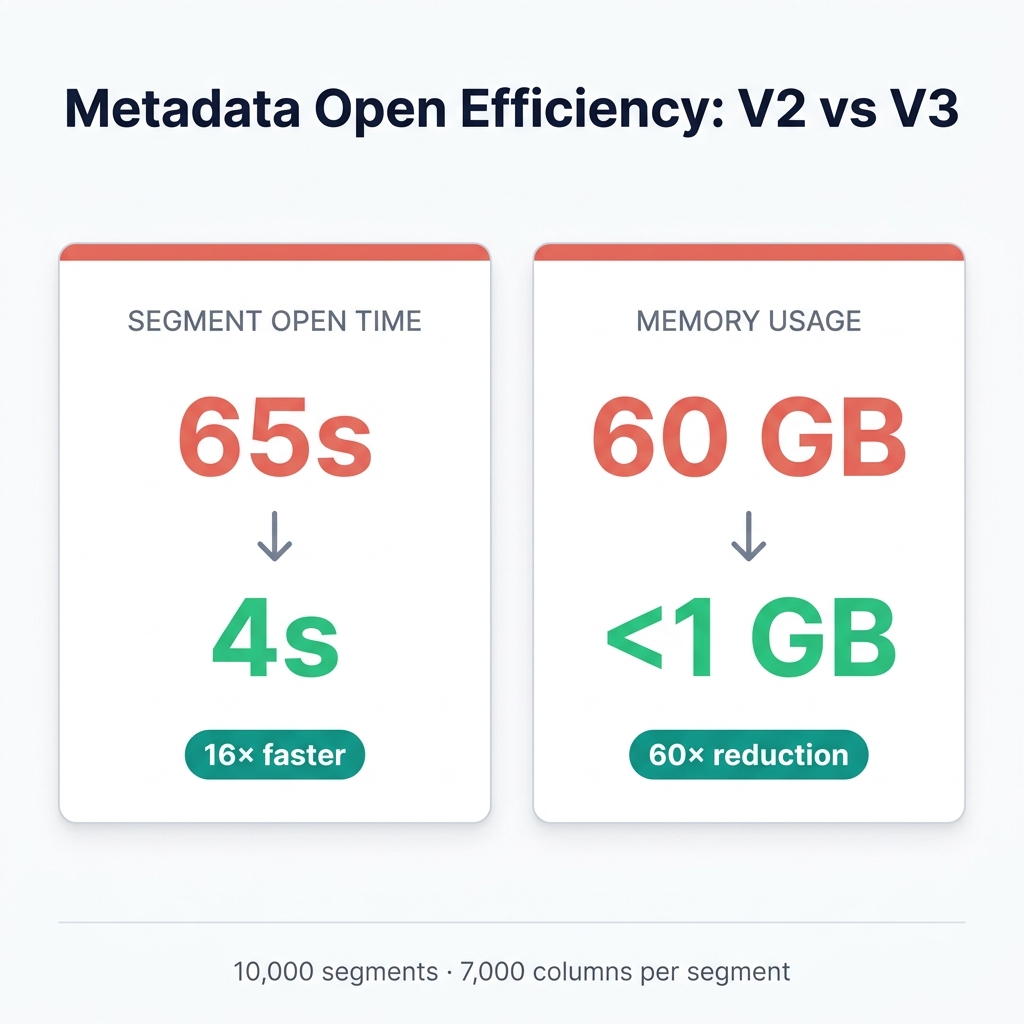
| Metric | V2 | V3 | Improvement |
|---|---|---|---|
| Segment open time | 65 s | 4 s | 16× faster |
| Memory during open | 60 GB | < 1 GB | 60× less |
With V2, the system must deserialize the entire Footer (containing all column metadata) even when the query reads only a few columns. That causes massive I/O and memory waste. V3 reads a slim Footer, then loads column metadata on demand.
When to Use V3
- Wide tables with hundreds or thousands of columns.
- Tables using
VARIANT, where subcolumn expansion can push the effective column count higher. - Object storage or tiered storage where metadata loading latency matters.
For tables with a small number of columns, V2 works fine. V3 helps most when the column count is large.
Usage
Specify storage_format as V3 in PROPERTIES when creating a table:
CREATE TABLE table_v3 (
    id BIGINT,
    name VARCHAR(128),
    attrs VARIANT
)
DISTRIBUTED BY HASH(id) BUCKETS 32
PROPERTIES (
    "storage_format" = "V3"
);