dbt-for-apache-doris 1.1.0 Released: Five Business Demos to Get Started with Doris Data Engineering
dbt-for-apache-doris 1.1.0 was released on August 12, 2026. It targets dbt Core 1.12, manages Apache Doris asynchronous materialized views through the standard dbt materialized_view materialization, and covers the everyday workflows: Table, View, Incremental, Snapshot, Seed, and Data Test.
python -m pip install "dbt-for-apache-doris==1.1.0"
The rest of this post covers what each of the two systems is responsible for, what the adapter supports today, and five demos that run a full pipeline in Doris.
1. dbt, Doris, and what 1.1.0 adds
1.1 What is dbt
dbt (data build tool) is an open-source data transformation framework that handles the T of ELT inside a data warehouse. Every model is a SQL SELECT statement, and models reference each other with ref(). dbt compiles them into the target database's table creation and write statements, runs them in dependency order, and materializes each one as a table, view, incremental table, or snapshot according to its configuration.
It exists because the transformation layer spent years without much engineering discipline:
- SQL is scattered across schedulers, repos, and personal machines. Dependencies are maintained by hand, and nobody can say for certain what a change will break.
- Nothing is tested automatically, so a wrong metric usually surfaces when someone in the business questions a number on a report.
- There is no version control, no code review, and no separation between development and production, which makes changes hard to trace afterwards.
- The same boilerplate for creating tables, writing incrementally, and keeping history gets rewritten in every project.
dbt's answer is models as code, a dependency graph derived from ref(), declarative Data Tests, built-in materializations (Table, View, Incremental, Snapshot), generated documentation and lineage, and a package ecosystem of Jinja macros such as dbt_utils.
1.2 What dbt and Doris solve together
dbt does not compute anything itself. Every transformation is pushed down to the target database, so that database sets the ceiling for the project. Apache Doris is an MPP real-time analytical database that speaks the MySQL protocol and runs aggregations, multi-table JOINs, and window functions in place. dbt-for-apache-doris connects the two: dbt organizes, orchestrates, and validates the transformation logic; Doris stores the data and executes the SQL.
Putting them together settles a few things that data teams otherwise handle by convention. Table conventions become part of the code, since Doris Key models, partitions, buckets, and table properties are declared in the model's config() and go through version control and code review with everything else, rather than living in someone's memory. Late-arriving data gets a defined path too: a write to a Doris Unique Key table is an Upsert, and dbt Incremental merge sits directly on that semantic, so replaying the same batch produces the same table and a failed job can simply be run again.
Pre-aggregation stops being a separate system. Doris asynchronous materialized views join the dbt dependency graph through the standard materialized_view materialization, with build and refresh strategy in the model configuration, so they change and get tested alongside the models they read from. The computation never leaves Doris. dbt only ships SQL, so no second engine is needed to move data around. Quality checks run in the same place: Data Tests, Unit Tests, and Model Contracts all execute against Doris at build time, which is a better moment to catch a broken metric than the morning after a report goes out.
1.3 Adapter feature support
-
Materializations
Capability Status Current scope and boundaries Table ✅ Duplicate Key CTAS; configurable HASH bucketing and bucket count, RANGE / LIST partitioning, table properties, Contracts, docs, Grants, and Hooks. Unique Key tables are created by Incremental mergeView ✅ Standard lifecycle, Contracts, docs, Grants, and Hooks; switching relation types is not zero-downtime Incremental ✅ Four strategies, append,merge,insert_overwrite, andmicrobatch, plus everyon_schema_changemode (strategy details in the next table)Snapshot ✅ check/timestampstrategies, hard-delete handling, schema evolution, atomic replacement and recovery; jobs targeting the same relation must be serialized by the schedulerMaterialized view ✅ Standard dbt materialized_view, implemented as a Doris Async MV; covers the build / refresh lifecycle, task waiting, configuration changes, atomic replacement and recovery; dbt jobs targeting the same relation must be serializedSeed ✅ CSV loading, type inference, column_types, andref()Ephemeral ✅ Compiled and inlined by dbt Core -
Incremental strategies and Doris target tables. When no strategy is specified explicitly, models configured with a
unique_keyusemergeand all others useappend.Strategy Doris target table Behavior appendDuplicate Key table Appends rows with INSERT INTOmergeUnique Key table (MoW or MoR) Full-row INSERT INTOUpsert based on Unique Key semantics; requiresunique_key, does not generateMERGE INTOinsert_overwriteAny writable Doris table INSERT OVERWRITEof the whole table, specified partitions, or dynamic partitions; does not acceptunique_keymicrobatchDuplicate Key table with exact RANGE partitions Each dbt time window overwrites one named partition; supports hour / day / month / year windows, and batches run serially -
dbt engineering capabilities
Capability Status Current scope and boundaries Sources and freshness ✅ loaded_at_field, filter, andloaded_at_query; cross-database access is implemented as database-as-schema, not through an External CatalogData Test ✅ Singular, Generic, and Ephemeral tests, plus store_failuresUnit Test ✅ Inline and CSV fixtures, case-insensitive column names, invalid-input validation, reserved-word quoting, and data type fixtures adapted to Doris Model Contract ✅ Column name and type constraints for Table, View, and Incremental; not mapped to database primary keys or NOT NULL constraints Persisted docs ✅ Table / column comments for Table, View, Incremental, Snapshot, Seed, and Async MV; updating a View comment, or a comment that contains both kinds of quotes, may require a rebuild or full refresh Grants ✅ Reconciles Doris table-level privileges for Table, View, Incremental, Seed, Snapshot, and Async MV, supporting useranduser@hostgrantees; role grantees are not handledHooks ✅ pre-hook and post-hook for every materialization; Doris does not provide transactional rollback for hook side effects Metadata and dbt docs catalog ✅ Relation discovery and documentation catalog for Doris databases, tables, views, columns, comments, and Async MVs Cross-database Sources ✅ References Sources in other Doris databases, including definitions that only declare a database; three-part External Catalog names are not supported
1.4 What's new in 1.1.0
1.1.0 is the first release of dbt-for-apache-doris from its own repository, and the first published to PyPI. It targets dbt Core 1.12 on Python 3.10 and above, manages Doris Async Materialized Views through the standard dbt materialized_view materialization, and ships with explicit version constraints and a stated support boundary.
A materialized_view model maps to a Doris Async MV, and the build mode, refresh strategy, and task waiting are all written in the model configuration:
{{ config(
    materialized='materialized_view',
    refresh_trigger='manual',
    wait_for_refresh=true
) }}

select order_date, sum(amount) as sales
from {{ ref('orders') }}
group by order_date
2. Five demos
Each demo starts from a business question:
| # | Demo | Business question | Transformation and result | Key capabilities |
|---|---|---|---|---|
| 01 | Daily order summary | How many valid orders and how much revenue per day and per month? | Filter out cancelled, returned, and failed orders; produce a daily Table and a monthly Async MV | Source, Table, Data Test, partitioning and bucketing, Async MV |
| 02 | Customer geography analysis | Which states are customers, orders, and revenue concentrated in? | Read addresses and orders from two Doris databases; output state-level business metrics | Cross-database Source, View, ref(), Table |
| 03 | Ad data integration | How to unify Google, Meta, and TikTok data? | Load three kinds of CSV with Seeds, align fields, and deduplicate; output daily channel details | Seed, dbt_utils, QUALIFY, Data Test |
| 04 | Late-arriving orders | How to absorb late corrections and avoid duplicate orders? | Identify order versions and maintain the current state with Incremental merge | Incremental, Unique Key, idempotency |
| 05 | Customer history tracking | How to keep the history of attribute changes and hard deletes? | Two Snapshot rounds produce SCD Type 2 history and a current customer dimension table | Snapshot, Hard Delete, ref(), Data Test |
The demos are selected and adapted from the Snowflake Labs
data-eng-benchscenarios (the original project is licensed under the Apache License 2.0). We rewrote the profiles, SQL, fixtures, verifiers, and notebooks for Apache Doris anddbt-for-apache-doris.Demo repository: https://github.com/velodb/dbt-for-apache-doris/tree/main/examples
Two of them are walked through below. For the other three, customer geography analysis, ad data integration, and customer history tracking, the Doris dbt demos README has the business description, the model list, and the exact commands.
2.1 Demo 01: Order summary and asynchronous materialized views
The demo starts from 6 orders in Doris, drops the CANCELLED, RETURNED, and FAILED ones, and builds daily_order_summary. Data Tests check that dates are unique and key columns are not null, and monthly_order_summary_mv then aggregates the daily table through ref().
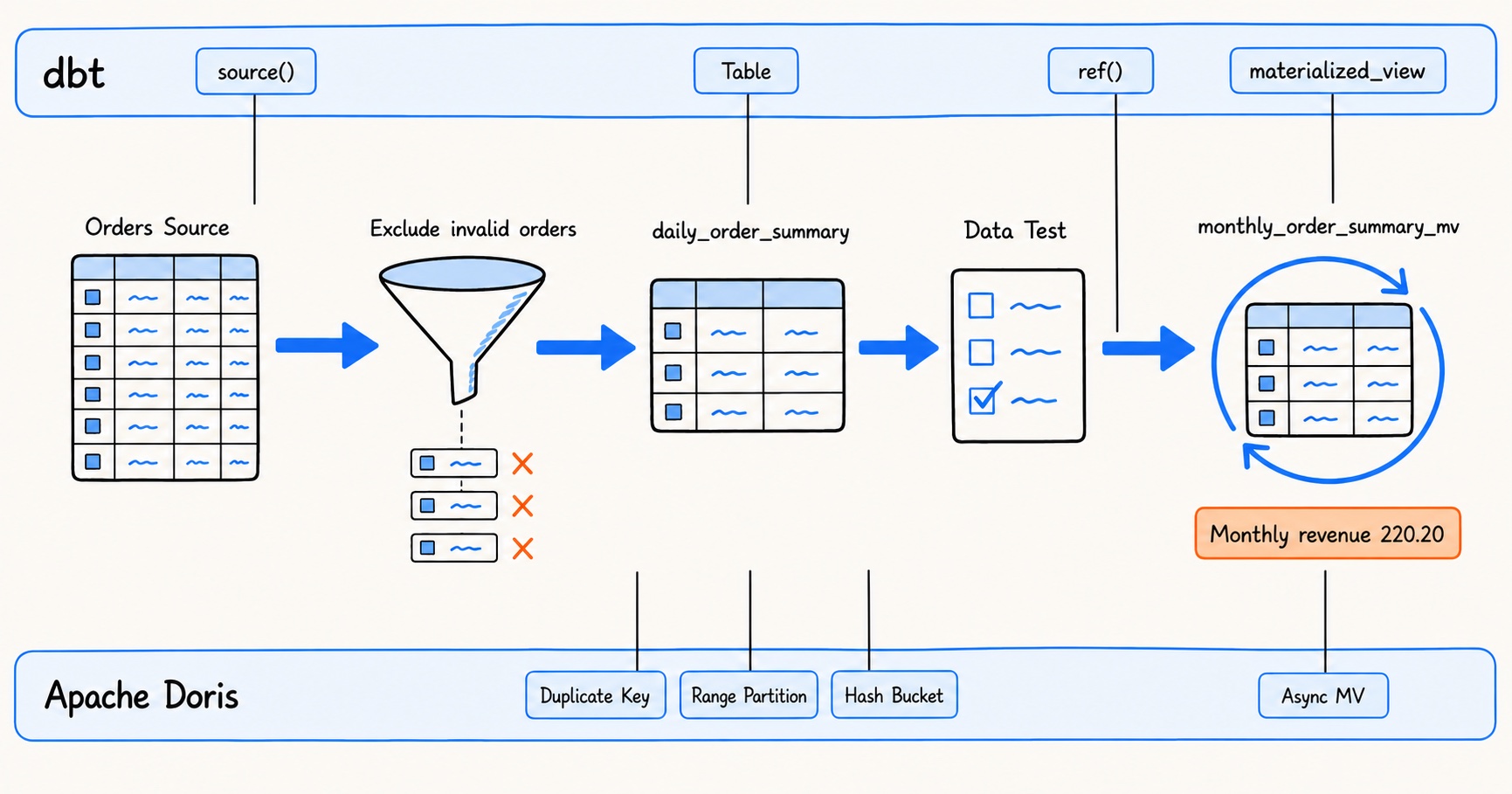
Figure 1: The chain from raw orders to the monthly asynchronous materialized view. The top row is what dbt handles: model dependencies, materialization, and tests. The bottom row is what Doris provides for the table model and the materialized view.
Three orders survive the filter, for a monthly revenue of 220.20. dbt owns the model dependencies (source() through ref()), the materializations, and the Data Tests. Doris decides how the two result tables are stored and how fast they answer:
| Doris capability | What it does here |
|---|---|
| Duplicate Key model | daily_order_summary is created with order_date as its sort key. Rows are stored as written, with no aggregation or merging. Date range queries use the prefix index, so daily report queries hit it directly. dbt table rebuilds the whole table with CTAS on every run, so the result is reproducible |
RANGE partitioning (by order_date) | The model pre-creates the p202608 partition and the catch-all pmax partition through partition_by_init. A monthly query scans one partition, and old data can be archived or dropped by month |
HASH bucketing (by order_date) | Data is distributed across BE nodes by the bucket key and computed in parallel. The demo runs on a single node with 1 bucket; production raises the bucket count as data grows |
| Asynchronous materialized view (Async MV) | monthly_order_summary_mv pre-aggregates on top of the daily table, so the monthly dashboard reads precomputed results and does not re-aggregate on every open. build_mode='immediate' produces data as soon as the view is built, refresh_method='auto' lets Doris choose between a full refresh and a partition-level one, and refresh_trigger='manual' makes each dbt run trigger a refresh and wait for it; a scheduled refresh (schedule) or a refresh on base table commit (commit) works as well. The materialized view itself also takes Keys, bucketing, and table properties |
2.2 Demo 04: Incremental updates for late-arriving orders
The demo writes orders 101, 102, and 103, then receives two late events: the amount of order 101 is corrected from 100.00 to 125.00, and a new order 104 arrives.
Two steps absorb them:
order_version_historyuses window functions to identify the current version of each order.incremental_daily_salestakesorder_idas its business key and runs Incrementalmergeon top of the Upsert semantics of the Doris Unique Key model.
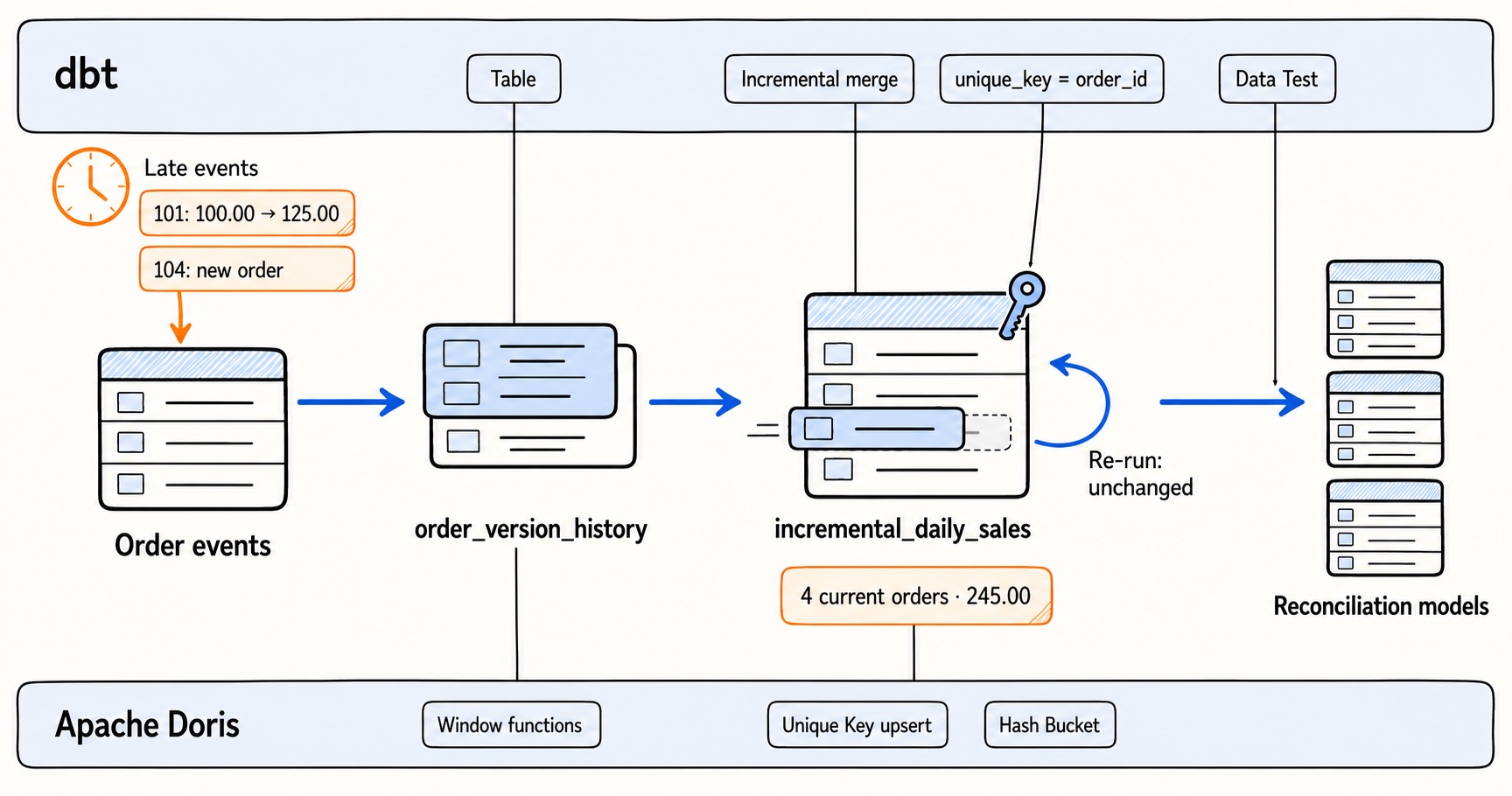
Figure 2: Late events reach the source table, then version identification and Incremental merge update the current orders; a re-run with no new data leaves the result alone. The top row is what dbt handles, the bottom row is what Doris provides.
Run it again with no new data and nothing moves. incremental_daily_sales holds 4 orders, order 101 now at 125.00, and revenue for August 1 in the downstream daily_sales_summary becomes 245.00. The same project also builds data quality, arrival latency, and revenue reconciliation models. dbt's part is the incremental model definition, the is_incremental() filter, and the uniqueness test on order_id. The "no duplicates, safe to re-run" property comes from Doris:
| Doris capability | What it does here |
|---|---|
| Unique Key model | incremental_daily_sales is created with order_id as its Unique Key. A new version of an order overwrites the old one on write, so the table always holds exactly one row per order and the unique test passes. The adapter enables Merge-on-Write by default, so deduplication happens at write time and queries have nothing left to merge |
Upsert on write (Incremental merge) | The adapter performs a full-row Upsert with a plain INSERT INTO, with no MERGE INTO and no delete-then-insert. The correction to order 101 and the new order 104 take the same write path, and re-running with no new data leaves the result unchanged, which is what makes backfills and retries safe |
HASH bucketing (by order_id) | The bucket key matches the primary key, so every version of an order lands in the same tablet, and primary key deduplication and updates complete inside it without comparing across nodes |
| Window functions | order_version_history uses row_number() and lead() inside Doris to mark the current version of each order and compute valid_from / valid_to. The version history is auditable, and no external program is involved |
| Online schema change | The model sets on_schema_change='append_new_columns'. When an upstream model adds a column, the adapter syncs the table structure with ALTER TABLE ... ADD COLUMN and waits for the change to finish, so the incremental table never needs a rebuild |
All five demos run as JupyterLab notebooks, one step per cell, so you can stop at any cell and look at what Doris wrote. They live in the repository's examples/ directory, with examples/doris-demos as the entry point; its README has the full run instructions.
Links
- GitHub repository: https://github.com/velodb/dbt-for-apache-doris
- 1.1.0 release: https://github.com/velodb/dbt-for-apache-doris/releases/tag/v1.1.0
- PyPI: https://pypi.org/project/dbt-for-apache-doris/1.1.0/
- Demo entry point: https://github.com/velodb/dbt-for-apache-doris/tree/main/examples/doris-demos
- Apache Doris all-in-one image: https://doris.apache.org/community/developer-guide/all-in-one-image