性能测试背后的优化
概述
Apache Doris 从 2.x 的倒排文本检索、3.x 的存算分离,演进到 4.x 的向量索引能力,正式迈入 AI 数据分析时代。本文面向以下读者:
- 想了解 Doris 4.x 向量索引为何能达到业界先进水平的架构师与开发者;
- 正在做向量数据库选型,需要理解 Doris 与专用向量库性能差异来源的技术决策者;
- 计划基于 Doris 进行 ANN 检索调优的运维与性能工程师。
文章按照向量检索的两大阶段组织:
| 阶段 | 核心目标 | 主要优化点 |
|---|---|---|
| 索引阶段 | 在不牺牲质量的前提下加速索引构建 | 多层级分片、双层并行、SIMD 距离计算 |
| 查询阶段 | 在高并发下控制 P99 延迟 | Prepare Statement、Index Only Scan、虚拟列、Scan 并行度、全局 TopN 延迟物化 |
索引阶段
索引阶段的性能与索引超参数强相关:质量越高,构建越慢。Doris 通过数据导入路径优化,在保持高索引质量的同时显著提升导入吞吐。
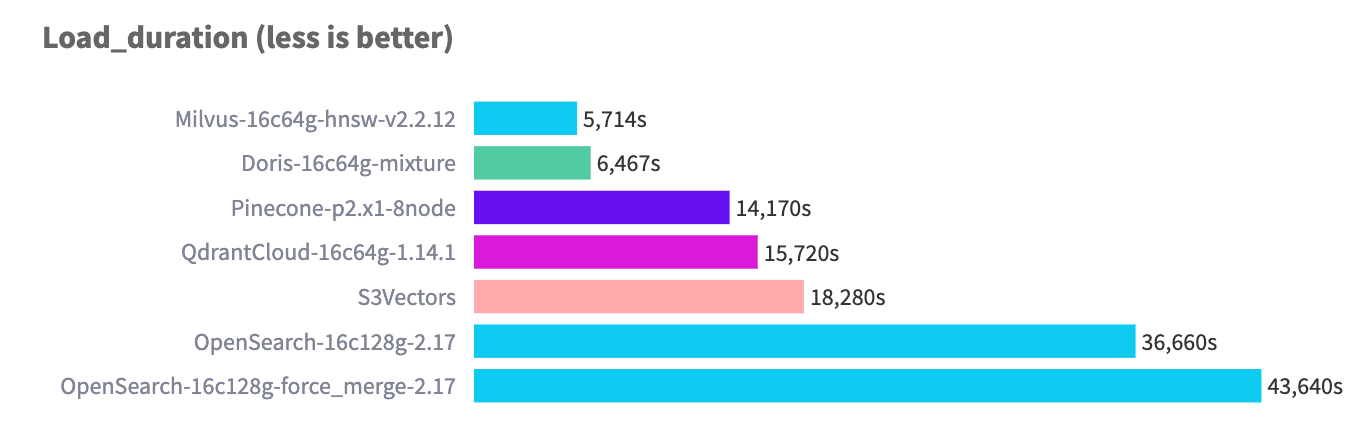
在 768 维、10M 行的数据规模上,Doris 的导入性能达到业界先进水平:
多层级分片
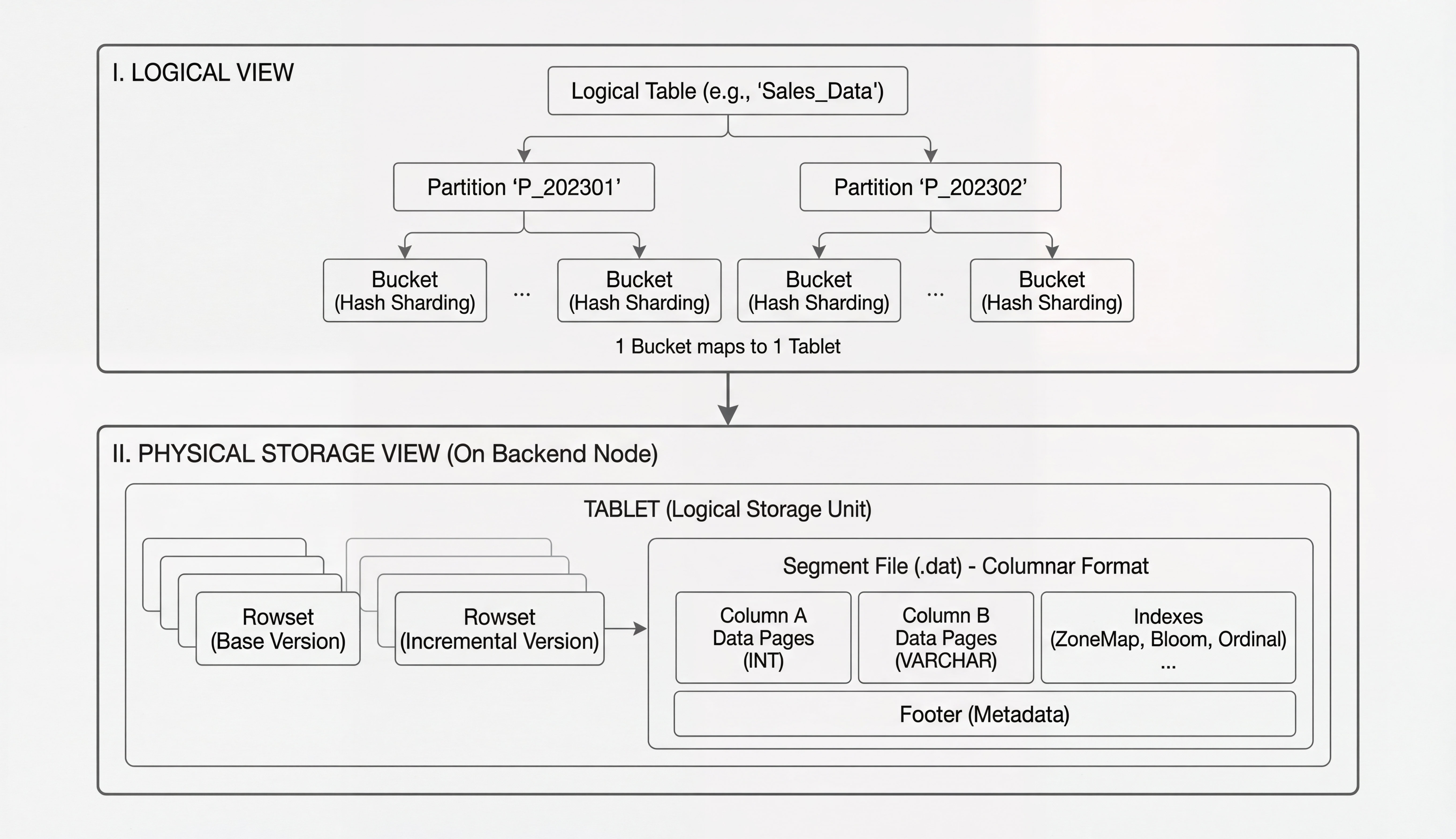
Doris 内表天然是分布式表。用户在查询或导入时仅感知到一张逻辑表(Table),而 Doris 内核会依据表定义自动创建物理分片,并按分区键与分桶键将数据路由到对应 BE 的 tablet。
各层级的关系如下:
| 层级 | 角色 |
|---|---|
| Table | 用户感知的逻辑表 |
| Tablet | 满足数量要求的物理分片 |
| Rowset | 每次导入事务在 tablet 上生成的版本控制单位 |
| Segment | rowset 下真正承载数据的文件,ANN 索引作用于 segment 粒度 |
向量索引(如 HNSW)依赖多个关键超参数,这些参数直接决定索引质量与查询性能,且通常需在固定数据规模下才能达到理想效果。
Doris 的多层级分片将"索引参数"与"整表数据规模"解耦:用户无需因数据总量增长而重建索引,只需关注每一批次的导入规模与对应参数设置。
基于实测,HNSW 索引在不同批次规模下的经验参数如下:
| batch_size | max_degree | ef_construction | ef_search | recall@100 |
|---|---|---|---|---|
| 250000 | 100 | 200 | 50 | 89% |
| 250000 | 100 | 200 | 100 | 93% |
| 250000 | 100 | 200 | 150 | 95% |
| 250000 | 100 | 200 | 200 | 98% |
| 500000 | 120 | 240 | 50 | 91% |
| 500000 | 120 | 240 | 100 | 94% |
| 500000 | 120 | 240 | 150 | 96% |
| 500000 | 120 | 240 | 200 | 99% |
| 1000000 | 150 | 300 | 50 | 90% |
| 1000000 | 150 | 300 | 100 | 93% |
| 1000000 | 150 | 300 | 150 | 96% |
| 1000000 | 150 | 300 | 200 | 98% |
换言之,用户只需聚焦"每一批次的导入数据量",并据此选择合适的索引参数,即可在保证索引质量的同时获得稳定的查询表现。
高性能索引构建
并行高质量索引构建
Doris 采用"双层并行"加速索引构建:
- 集群级并行:通过多台 BE 节点同时构建;
- 节点内并行:在每台 BE 内对同一批数据分组进行多线程距离计算,提升索引数据结构的构建速度。
在"快"的同时,Doris 通过内存攒批提升索引质量:当总向量数固定但分批过细、频繁追加索引时,图结构容易稀疏、召回率下降。
举例:对 768D / 10M 的向量数据:
- 分 10 次构建索引,召回率约 99%;
- 分 100 次构建索引,召回率可能降至约 95%。
通过内存攒批,在相同超参数下可更好地平衡内存占用与图质量,避免因过度分批导致的质量劣化。
SIMD 距离计算
ANN 索引构建的核心成本在大规模距离计算,属典型 CPU 密集型任务。Doris 将这部分计算集中在 BE 节点,相关实现以 C++ 编写,并充分利用 Faiss 的自动与手动向量化优化。
以 L2 距离为例,Faiss 通过编译器辅导宏触发自动向量化:
FAISS_PRAGMA_IMPRECISE_FUNCTION_BEGIN
float fvec_L2sqr(const float* x, const float* y, size_t d) {
    size_t i;
    float res = 0;
    FAISS_PRAGMA_IMPRECISE_LOOP
    for (i = 0; i < d; i++) {
        const float tmp = x[i] - y[i];
        res += tmp * tmp;
    }
    return res;
}
FAISS_PRAGMA_IMPRECISE_FUNCTION_END
FAISS_PRAGMA_IMPRECISE_* 宏可引导编译器进行自动向量化:
#define FAISS_PRAGMA_IMPRECISE_LOOP \
    _Pragma("clang loop vectorize(enable) interleave(enable)")
同时,Faiss 在 #ifdef SSE3/AVX2/AVX512F 条件块中使用 _mm* / _mm256* / _mm512* 指令进行显式向量化;结合模板 ElementOpL2 / ElementOpIP(分别实现 L2 与点积的逐分量操作)与维度特化 fvec_op_ny_D{1,2,4,8,12},实现:
- 批量处理多条样本(如 8/16),并通过寄存器内矩阵转置(如
transpose_8x2/16x4/...)提升访问连续性; - FMA 指令(如
_mm512_fmadd_ps)合并乘加以减少指令数; - 水平求和(horizontal sum)快速得到标量结果;
- masked 分支处理非 4/8/16 对齐的尾元素。
这些优化有效压缩距离计算的指令与访存开销,显著提升索引构建吞吐。
查询阶段
搜索场景对延迟极为敏感。在千万级数据量与高并发查询的场景下,通常需将 P99 延迟控制在 500 ms 以内。这对 Doris 的优化器、执行引擎以及索引实现都提出了更高要求。
开箱即用的测试表明,Doris 的查询性能已达到业界主流专用向量数据库的水平。下图展示了 Doris 与其他具备向量搜索能力的数据库在 Performance768D10M 数据集上的对比;其他数据库数据来自 Zilliz 开源的 VectorDBBench 框架:
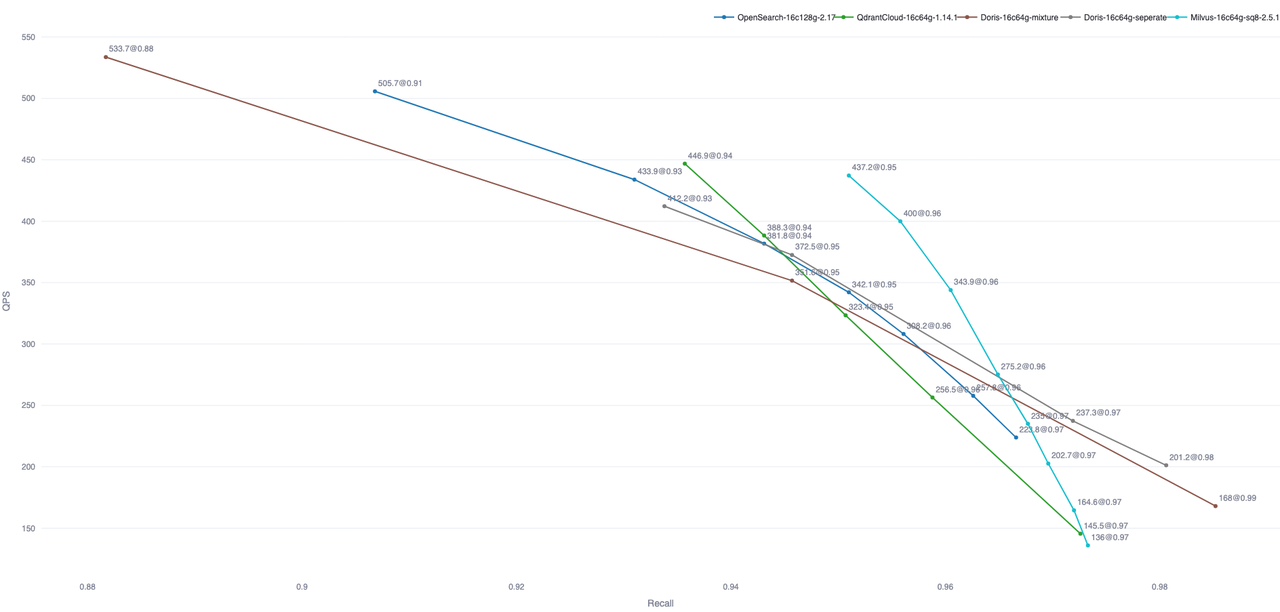
注:图中仅包含部分数据库的开箱测试结果。OpenSearch 与 Elastic Cloud 可通过优化索引文件数量进一步提升查询性能。
查询阶段的优化围绕一个核心目标展开:消除重复计算与多余的磁盘 IO,并最大化并发性能。具体手段如下:
Prepare Statement
在传统执行路径中,Doris 会对每条 SQL 执行完整优化流程(语法解析、语义分析、RBO、CBO)。这在通用 OLAP 场景必不可少,但在搜索等简单且高度重复的查询模式中会产生明显的额外开销。
Doris 4.0 扩展了 Prepare Statement,使其不仅支持点查,也适用于包含向量检索在内的所有 SQL 类型。核心思路:
- 分离编译与执行
- Prepare 阶段一次性完成解析、语义与优化,生成可复用的逻辑计划(Logical Plan);
- Execute 阶段仅绑定实参并直接执行已生成的计划,完全跳过优化器。
- 计划缓存(Plan Cache)
- 按 SQL 指纹(normalized SQL + schema version)判断计划是否可复用;
- 参数值不同但结构一致时仍可直接复用,避免重复优化。
- Schema Version 校验
- 执行时校验表结构版本,确保计划正确性;
- schema 未变化时直接复用;已变化时自动失效并重新 Prepare。
- 跳过优化器带来显著加速
- Execute 不再运行 RBO/CBO,优化器耗时几乎被完全消除;
- 在向量检索这类模板化查询中,Prepare 可显著降低端到端延迟。
Index Only Scan
Doris 的向量索引采用外挂方式。外挂索引便于管理与异步构建,但也带来性能挑战:如何避免重复计算与多余 IO。
ANN 索引除返回命中行号外,还可返回向量间距离。为高效利用这些额外信息,执行引擎在 Scan 算子阶段对距离相关表达式进行"提前短路"。Doris 通过"虚拟列"机制自动完成该短路,并以 Ann Index Only Scan 完全消除与距离计算相关的读 IO。
朴素流程:Scan 将谓词下推至索引,索引返回行号;Scan 按行号读取数据页(Data Page),再计算表达式并向上返回 N 行结果。
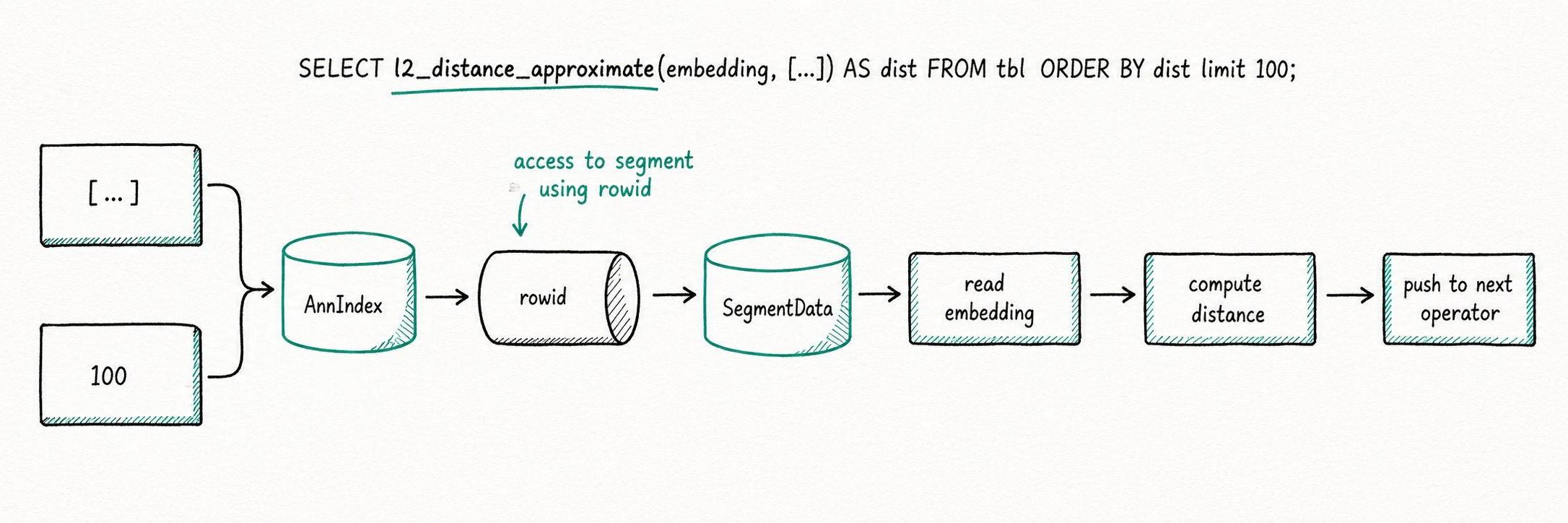
应用 Index Only Scan 后:
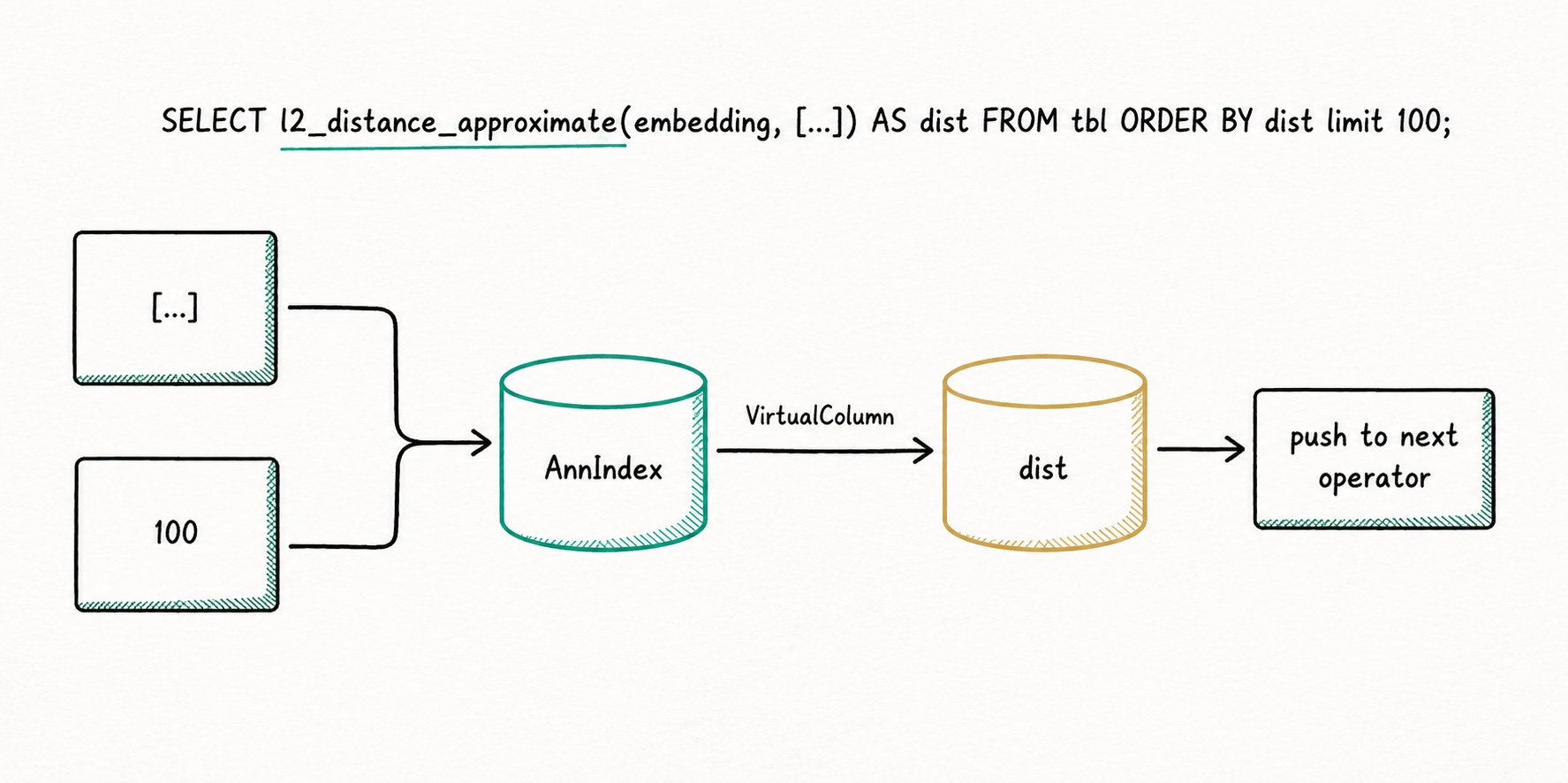
例如:
SELECT l2_distance_approximate(embedding, [...]) AS dist
FROM tbl
ORDER BY dist
LIMIT 100;
执行过程将不再触发数据文件 IO。
支持 Index Only Scan 的查询类型
除 Ann TopN Search 外,支持索引加速的 Range Search 与复合检索(Compound Search)也采用类似优化。Range Search 较 TopN 更复杂:不同比较方式决定索引是否能返回 dist。下表梳理与 Ann Index Only Scan 相关的查询类型:
| 编号 | 模式 | 是否走 IndexScan | 关键原因 |
|---|---|---|---|
| Sql1 | Range + proj,dist <= 10 | True | 索引可返回 dist,virtual column for cse 避免 proj 中的 dist 重算 |
| Sql2 | Range + no-proj,dist <= 10 | True | 索引可返回 dist |
| Sql3 | Range + proj,dist > 10 | False | 索引无法返回 dist,proj 要求 dist 故需重读 embedding |
| Sql4 | Range + proj,dist > 10,proj 不要 dist | True | proj 不需要 dist,无需重读 embedding |
| Sql5 | TopN | True | 索引返回 dist,virtual slot 上传到 proj |
| Sql6 | TopN + IndexFilter | True | comment 列由倒排索引扫描已优化,embedding 不读 |
| Sql7 | TopN + Range | True | Sql1 与 Sql5 的组合 |
| Sql8 | TopN + Range + IndexFilter | True | Sql6 与 Sql7 的组合 |
| Sql9 | TopN + Range + CommonFilter(dist < 10) | False | common filter 残留导致 embedding 仍被物化(ROI 不高暂不优化) |
| Sql10 | Sql9 变种(dist > 10) | False | 索引无法返回 embedding,需物化以计算 abs |
| Sql11 | Sql9 变种(array_size(embedding) > 10) | False | array_size 强制要求 embedding 物化 |
完整 SQL 与详细注释如下:
-- Sql1
-- Range + proj
-- Ann 索引可以返回 dist,所以 dist 不需要再次计算
-- 同时 virtual column for cse 的优化避免了 proj 里面的 dist 计算
-- IndexScan: True
select id, dist(embedding, [...]) from tbl where dist <= 10;

-- Sql2
-- Range + no-proj
-- Ann 索引可以返回 dist,所以 dist 不需要再次计算
-- IndexScan: True
select id from tbl where dist <= 10 order by id limit N;

-- Sql3
-- Range + proj + no-dist-from index
-- Ann 索引无法返回 dist(索引只能更新 rowid map)
-- 由于 proj 里面要求返回 dist 因此 embedding 需要重读
-- IndexScan: False
select id, dist(embedding, [...]) from tbl where dist > 10;

-- Sql4
-- Range + proj + no-dist-from index
-- Ann 索引无法返回 dist(索引只能更新 rowid map)
-- 但是 proj 里面不需要 dist,因此 embedding 不需要重新读
-- IndexScan: True
select id from tbl where dist > 10;

-- Sql5
-- TopN
-- AnnIndex 返回 dist,virtual slot for cse 确保了索引的 dist 被上传到 proj
-- 因此不需要读 embedding 列
-- IndexScan: True
select id[, dist(embedding, [...])] from tbl order by dist(embedding, [...]) asc limit N;

-- Sql6
-- TopN + IndexFilter
-- 1. comment 列不需要读,inverted index scan 已经做了这个优化
-- 2. embedding 列不需要读,原因与 sql5 一样
-- IndexScan: True
select id[, dist(embedding, [...])] from tbl where comment match_any 'olap' ORDER BY dist(embedding, [...]) LIMIT N;

-- Sql7
-- TopN + Range
-- IndexScan:True,原因是 Sql1 与 Sql5 组合
select id[, dist(embedding, [...])] from tbl where dist(embedding, [...]) > 10 order by dist(embedding, [...]) limit N;

-- Sql8
-- TopN + Range + IndexFilter
-- INdexScan:True,原因是 Sql7 与 Sql6 组合
select id[, dist(embedding, [...])] from tbl where comment match_any 'olap' and dist(embedding, [...]) > 10 ORDER BY dist(embedding, [...]) LIMIT N;

-- Sql9
-- TopN + Range + CommonFilter
-- 这里重点: 1. dist < 10 而不是 dist > 10; 2. common filter 没有直接读 embedding,而是读的 dist
-- Ann index 可以返回 dist,virtual slot ref for cse 确保了所有对 dist 的读都是同一个列
-- 此时虽然 ann topn 无法 apply,理论上 embedding 列依然全程不需要物化
-- 但是实际中,依然还是会物化 embedding,因为目前判断某个列是否可以 skip reading,是靠判断这个列上的谓词是否还有残留,common filter 本身无法被消除,所以现在代码上是会判断需要物化的。
-- 这个优化点 ROI 不高,因此不做了
-- IndexScan: False
select id[,dist(embedding, [...])] from tbl where where comment match_any 'olap' and dist(embedding, [...]) < 10 AND abs(dist(embedding) + 10) > 10 ORDER BY dist(embedding, [...]) LIMIT N;

-- Sql10
-- Sql9 的变种,dist < 10 变成了 dist > 10,此时 index 无法返回 embedding
-- 因此为了计算 abs(dist(embedding, [...]) 需要物化 embedding
-- IndexScan: False
select id[,dist(embedding, [...])] from tbl where where comment match_any 'olap' and dist(embedding, [...]) > 10 AND abs(dist(embedding) + 10) > 10 ORDER BY dist(embedding, [...]) LIMIT N;

-- Sql11
-- Sql9 的变种,abs(dist(embedding) + 10) > 10 变成了 array_size(embedding) > 10,区别在于 array_size 强制要求 embedding 的物化
-- 为了计算 array_size(embedding, [...]) 需要物化 embedding
-- IndexScan: False
select id[,dist(embedding, [...])] from tbl where where comment match_any 'olap' and dist(embedding, [...]) < 10 AND array_size(embedding) > 10 ORDER BY dist(embedding, [...]) LIMIT N;
虚拟列优化公共子表达式
Index Only Scan 主要解决 IO 问题,避免对 embedding 的大量随机读。为进一步消除重复计算,Doris 在计算层引入"虚拟列"机制,将索引返回的 dist 以列形式传递给表达式执行器。
虚拟列的设计要点:
- 引入表达式节点
VirtualSlotRef:表示"计算时生成"的特殊列,由某个表达式物化且可被多个表达式共享,仅首次使用时计算一次,从而消除 Projection 与谓词中的公共子表达式(CSE)重复计算。 - 引入列迭代器
VirtualColumnIterator:用于将索引返回的距离物化到表达式,避免重复的距离函数计算。
该机制最初用于 ANN 相关查询的 CSE 消除,随后扩展至通用的 Projection + Scan + Filter 组合。
实测效果
基于 ClickBench 数据集,统计从 Google 获得最多点击的 20 个网站:
set experimental_enable_virtual_slot_for_cse=true;

SELECT counterid,
       COUNT(*)               AS hit_count,
       COUNT(DISTINCT userid) AS unique_users
FROM   hits
WHERE  ( UPPER(regexp_extract(referer, '^https?://([^/]+)', 1)) = 'GOOGLE.COM'
         OR UPPER(regexp_extract(referer, '^https?://([^/]+)', 1)) = 'GOOGLE.RU'
         OR UPPER(regexp_extract(referer, '^https?://([^/]+)', 1)) LIKE '%GOOGLE%' )
       AND ( LENGTH(regexp_extract(referer, '^https?://([^/]+)', 1)) > 3
              OR regexp_extract(referer, '^https?://([^/]+)', 1) != ''
              OR regexp_extract(referer, '^https?://([^/]+)', 1) IS NOT NULL )
       AND eventdate = '2013-07-15'
GROUP  BY counterid
HAVING hit_count > 100
ORDER  BY hit_count DESC
LIMIT  20;
核心表达式 regexp_extract(referer, '^https?://([^/]+)', 1) 为 CPU 密集型且被多处复用。开关虚拟列优化的对比:
| 状态 | 耗时 |
|---|---|
| 关闭优化 | 1.50 s |
开启优化(set experimental_enable_virtual_slot_for_cse=true) | 0.57 s |
端到端性能提升约 3 倍。
Scan 并行度优化
Doris 针对 Ann TopN Search 重构了 Scan 并行策略。
| 维度 | 原策略 | 新策略 |
|---|---|---|
| 并行度判定依据 | 行数(默认 2,097,152 行 / Scan Task) | 严格按 segment 创建 Scan Task |
| 高维向量场景表现 | 单 segment 行数远低于阈值,多 segment 串行扫描 | 索引分析阶段并行度提升 |
| 回表影响 | — | Ann TopN 过滤率高,回表串行不影响整体性能 |
以 SIFT 1M 为例:开启 set optimize_index_scan_parallelism=true; 后,TopN 串行查询耗时由 230 ms 降至 50 ms。
此外,4.0 引入"动态并行度调整":每轮调度前根据 Scan 线程池压力动态决定可提交的任务数;压力大则减并行、资源空闲则增并行,以在串行与高并发场景间兼顾资源利用率与调度开销。
全局 TopN 延迟物化
典型的 Ann TopN 查询包含两阶段:
- 阶段一:Scan 算子通过索引获取各 segment 的 TopN 距离;
- 阶段二:全局排序节点对各 segment 的 TopN 进行合并排序,得到最终 TopN。
若 projection 返回多列或包含大列(如 String),阶段一从每个 segment 读取的 N 行可能造成大量磁盘 IO,且在阶段二的全局排序中被丢弃(非最终 TopN)。Doris 通过"全局 TopN 延迟物化"最大限度减少阶段一读取量。
以下例为例:
SELECT id, l2_distance_approximate(embedding, [...]) AS dist
FROM tbl
ORDER BY dist
LIMIT 100;
执行流程:
- 阶段一:每个 segment 通过 Ann Index Only Scan + 虚拟列仅输出 100 个
dist及其rowid; - 阶段二:若共有 M 个 segment,对
100 * M个dist做全局排序得到最终 TopN 及其rowid; - 最后由 Materialize 算子依据这些
rowid在对应 tablet/rowset/segment 上物化所需列。